

Dermatomyositis and polymyositis are rare autoimmune diseases that attack the body’s own muscles, causing chronic inflammation, progressive weakness, and in dermatomyositis, distinctive skin rashes. These conditions don’t show up on a routine blood test, and many patients spend years going from doctor to doctor before getting the right diagnosis. By the time symptoms are clear-like struggling to climb stairs or lift a coffee cup-it’s often already advanced. But modern treatment can turn the tide. With early, aggressive care, most people regain strength and return to daily life. This isn’t about slowing decline. It’s about reclaiming function.
What Sets Dermatomyositis Apart from Polymyositis?
At first glance, dermatomyositis (DM) and polymyositis (PM) look nearly identical. Both cause symmetrical weakness in the muscles closest to your trunk: hips, thighs, shoulders, neck. You might find yourself using your arms to push up from a chair, or dropping things because your grip weakens. But the difference is in the skin.
Dermatomyositis always includes skin changes. The most telling sign is the heliotrope rash-a purplish, swollen rash on the eyelids. It’s often mistaken for allergies or tiredness. Other common rashes appear over the knuckles (Gottron’s papules), elbows, knees, and the V of the neck. These aren’t just cosmetic. They’re markers of active disease and signal that the immune system is attacking muscle tissue in a very specific way.
Polymyositis has no skin involvement. If you have muscle weakness without rashes, it’s more likely PM. But here’s the catch: about 30% of cases are misdiagnosed at first. Symptoms can mimic fibromyalgia, thyroid problems, or even normal aging. That’s why blood tests and imaging matter.
How Doctors Diagnose These Conditions
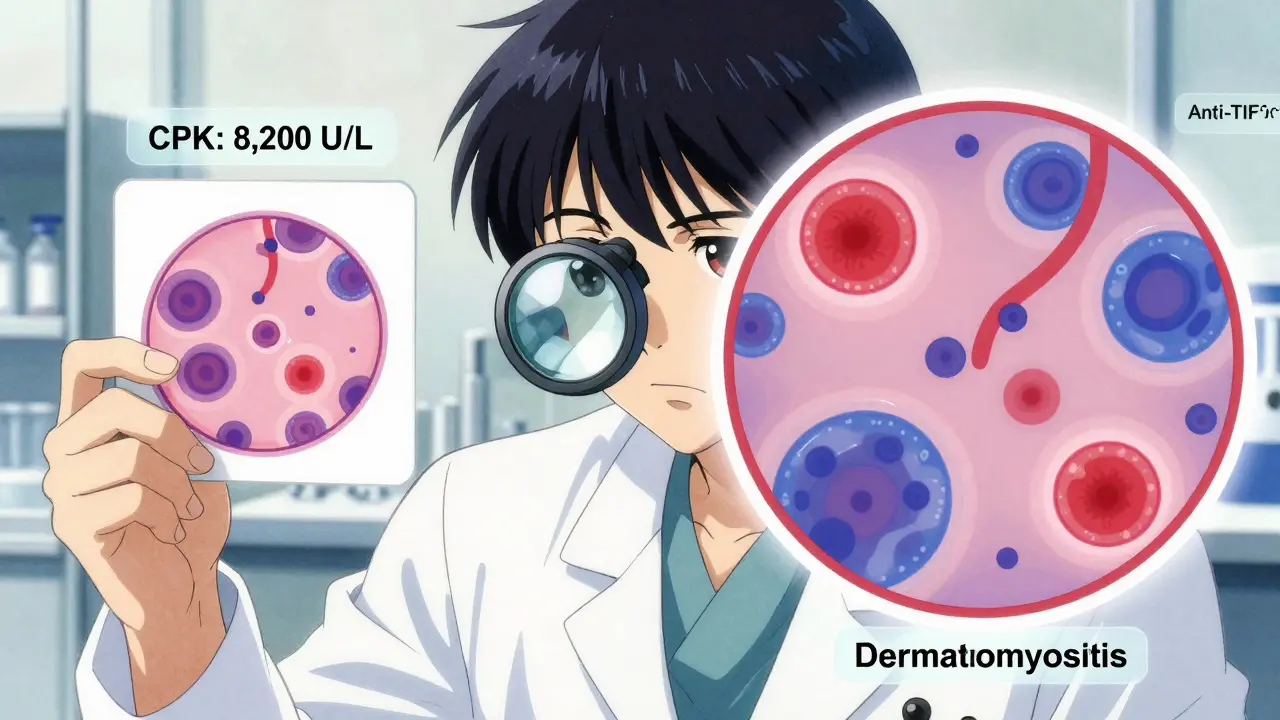
Diagnosis isn’t quick. It usually takes 3 to 6 months from the first symptom to confirmation. It starts with blood tests. Elevated creatine phosphokinase (CPK) is a red flag. Normal levels are 10-120 U/L. In active disease, levels can spike to 8,000 U/L or higher. You’ll also see high ESR and CRP-markers of inflammation.
Next comes electromyography (EMG). This test checks how well your muscles respond to nerve signals. In both DM and PM, EMG shows short, low-amplitude signals and spontaneous electrical activity-signs of damaged muscle fibers.
But the gold standard is the muscle biopsy. In polymyositis, you’ll see T cells invading individual muscle fibers. In dermatomyositis, the damage is more about blood vessels: inflammation around them, and a pattern called perifascicular atrophy-where muscle fibers at the edges of bundles shrink and die. This distinction isn’t just academic. It guides treatment.
For dermatomyositis, doctors also check for cancer. About 1 in 5 adults with DM develop an underlying tumor-often ovarian, lung, or colon cancer. That’s why a full cancer screen (mammogram, colonoscopy, CT scans) is part of the initial workup. Polymyositis doesn’t carry the same cancer risk.
Why Treatment Starts With Steroids-And Why It’s Not Enough
Corticosteroids like prednisone are the first line of defense. The typical starting dose is 1 mg per kilogram of body weight daily-that’s about 60 mg for a 70 kg adult. Within 4 to 8 weeks, most people see improvement. Muscle strength improves. CPK levels drop.
But steroids are a double-edged sword. Long-term use leads to serious side effects: 30-50% of patients develop osteoporosis. 15-30% develop diabetes. 20-40% get cataracts. Weight gain, insomnia, mood swings-these aren’t rare. They’re expected. That’s why tapering is slow and careful, and why doctors add other drugs early.
Second-line treatments are critical. Methotrexate, azathioprine, and mycophenolate mofetil are immunosuppressants that help reduce steroid doses. One Reddit user shared that after 9 months of prednisone alone, his CPK was still at 8,200 U/L. Adding methotrexate brought it down to 450 U/L in four months. He cut his steroid dose from 40 mg to 10 mg. That’s not an outlier-it’s a common success story.
For tough cases of dermatomyositis, intravenous immunoglobulin (IVIG) is often used. It’s expensive and requires weekly infusions, but studies show it works where other drugs fail. Rituximab, a drug that targets B cells, has shown 60-70% response rates in refractory cases. It’s not FDA-approved for these conditions, but it’s used off-label with strong evidence.
The Role of Physical Therapy and Daily Life
Rest isn’t the answer. Inactivity makes muscles weaker faster. Physical therapy starts within two weeks of diagnosis. The goal isn’t to push through pain-it’s to move gently, consistently. Low-resistance exercises like swimming, cycling, or light weight training help maintain muscle mass without triggering inflammation.
A 2022 report from the Hospital for Special Surgery found that patients who stuck with a structured rehab program improved functional capacity by 35-45% in six months. That means going from needing help to stand up to doing it on your own. From avoiding stairs to climbing them without breathlessness.
But not all symptoms are muscular. About 15-30% of patients have trouble swallowing (dysphagia). This can lead to choking or pneumonia. Speech pathologists help with swallowing exercises and diet changes. A 2022 survey of over 1,200 patients found that 37% had dysphagia. Many didn’t realize it was part of their disease until it was pointed out.
Fatigue is another hidden battle. Sixty-eight percent of patients reported extreme tiredness that limited daily activities. It’s not laziness. It’s inflammation in the muscles and nervous system. Sleep hygiene, pacing activities, and avoiding overheating help manage it.

New Hope: Emerging Treatments and Better Diagnosis
The landscape is changing fast. In 2023, the American College of Rheumatology presented data from the IMACS trial showing that JAK inhibitors like tofacitinib improved skin rashes by 65% and muscle strength by 52% in refractory dermatomyositis over 24 weeks. These drugs block specific immune signals and are already used for rheumatoid arthritis.
Another promising drug is abatacept, which modulates T cell activity. A 2023 NIH trial (NCT04981239) found that 40% of polymyositis patients achieved minimal disease activity after six months. It’s still experimental, but the results are encouraging.
Diagnostic delays are also shrinking. In June 2023, the European League Against Rheumatism (EULAR) updated its guidelines to include myositis-specific antibodies (MSAs) as key diagnostic tools. These blood markers-like anti-Mi-2, anti-Jo-1, anti-TIF1γ-help classify subtypes and predict complications. For example, anti-TIF1γ is strongly linked to cancer-associated dermatomyositis. Testing for them can cut diagnosis time by 30-40%.
Long-Term Outlook: Survival, Side Effects, and Support
Twenty years ago, 10-year survival for these diseases was around 50%. Today, it’s over 80% for dermatomyositis and 85% for polymyositis. That’s thanks to early diagnosis and combination therapy.
But survival isn’t the whole story. Quality of life matters. A 2022 study found that 41% of patients suffered moderate to severe steroid side effects. Weight gain was reported by 82% of those affected. Insomnia by 67%. Managing these isn’t optional-it’s part of treatment.
Support systems make a difference. Patients who joined structured education programs reduced hospital readmissions by 22%. Learning how to monitor symptoms, track medication, and recognize warning signs (like sudden weakness or trouble breathing) empowers people to act before crises hit.
The biggest challenge? Access. Only 3 drugs are FDA-approved for dermatomyositis-none for polymyositis. Most treatments are used off-label. Insurance often delays coverage for second-line drugs, with prior authorizations taking an average of 17 days. And there’s a shortage of rheumatologists. In the U.S., one specialist serves about 10,000 people with autoimmune conditions. That’s why patient advocacy groups and online communities are vital.
There’s no cure yet. But there’s control. With the right team-rheumatologist, physical therapist, nutritionist, speech pathologist-most people don’t just survive. They live.
Can dermatomyositis and polymyositis be cured?
No, there is no known cure for either condition. However, with early and aggressive treatment, most patients achieve remission or low disease activity. Muscle strength can improve significantly, and many return to normal daily activities. Treatment focuses on controlling inflammation, preventing damage, and managing side effects.
How long does it take to get diagnosed?
On average, diagnosis takes 3 to 6 months from the first symptom. Many patients see multiple doctors and undergo several tests-including blood work, EMG, MRI, and muscle biopsy-before a definitive diagnosis is made. Misdiagnosis occurs in about 30% of cases, often because symptoms resemble fibromyalgia, thyroid disease, or normal aging.
Is dermatomyositis linked to cancer?
Yes, about 20% of adults with dermatomyositis develop an underlying cancer, most commonly ovarian, lung, or gastrointestinal cancers. That’s why a full cancer screening is standard at diagnosis. Polymyositis does not carry the same cancer risk. Regular follow-ups are recommended for at least 3-5 years after diagnosis.
What are the main side effects of steroid treatment?
Long-term steroid use can cause osteoporosis (affecting 30-50% of patients), diabetes (15-30%), cataracts (20-40%), weight gain, insomnia, mood swings, and increased infection risk. Doctors often prescribe calcium, vitamin D, and bone-strengthening medications to reduce these risks. Tapering steroids as soon as possible and using other immunosuppressants helps minimize exposure.
Can physical therapy help with muscle weakness?
Yes, structured physical therapy is essential. Low-resistance exercises like swimming, cycling, and light resistance training improve muscle strength and function by 35-45% over six months. The goal is to prevent atrophy without overloading inflamed muscles. Starting therapy within two weeks of diagnosis leads to better long-term outcomes.
Are there new treatments on the horizon?
Yes. JAK inhibitors like tofacitinib have shown strong results in refractory dermatomyositis, improving skin and muscle symptoms by over 50% in clinical trials. Abatacept, which targets T cells, is being tested for polymyositis with promising early results. Myositis-specific antibody testing is now part of diagnostic guidelines, helping speed up diagnosis and tailor treatment. These advances are making long-term control more achievable than ever.


Author
Mike Clayton
As a pharmaceutical expert, I am passionate about researching and developing new medications to improve people's lives. With my extensive knowledge in the field, I enjoy writing articles and sharing insights on various diseases and their treatments. My goal is to educate the public on the importance of understanding the medications they take and how they can contribute to their overall well-being. I am constantly striving to stay up-to-date with the latest advancements in pharmaceuticals and share that knowledge with others. Through my writing, I hope to bridge the gap between science and the general public, making complex topics more accessible and easy to understand.