
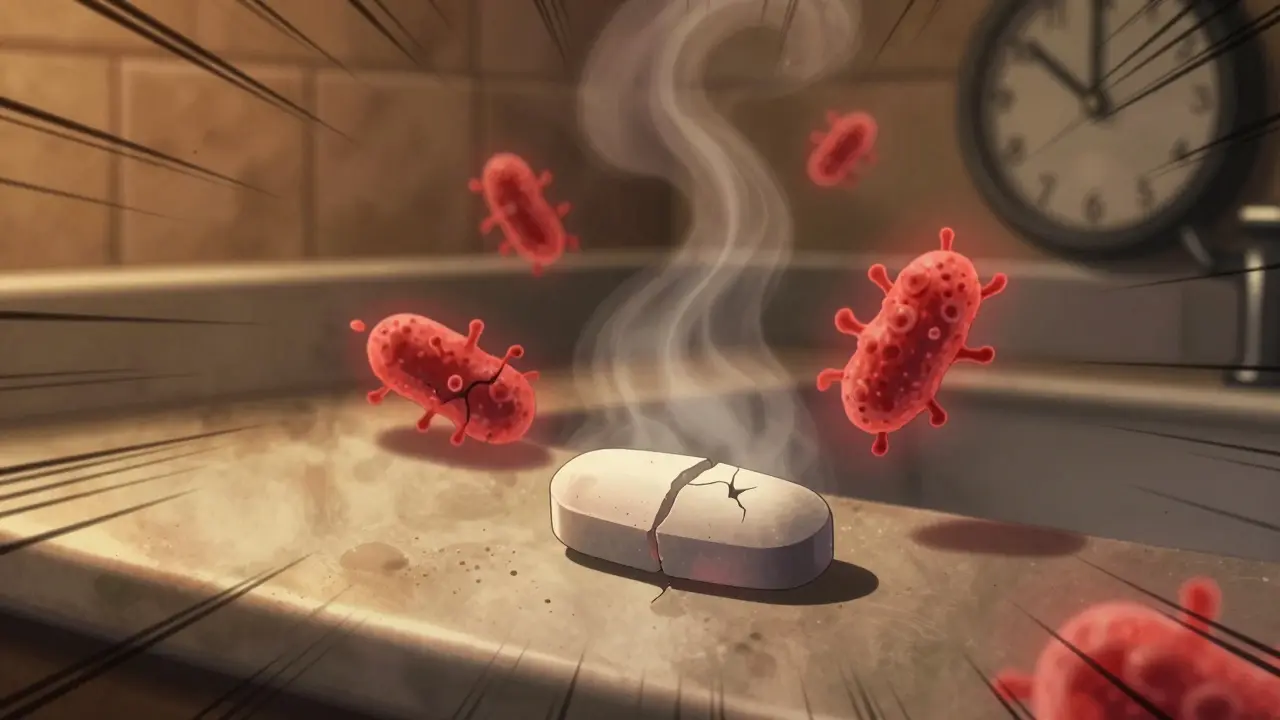
Most people assume that if a pill is past its expiration date, it’s just useless-maybe a little dusty, maybe a little stale. But with antibiotics, the stakes are higher than just a wasted pill. Taking an expired antibiotic might not just fail to cure your infection-it could make things worse by helping bacteria become stronger and harder to treat.
What Does an Expiration Date Actually Mean?
The expiration date on your antibiotic bottle isn’t a "use-by" date like milk. It’s the last day the manufacturer guarantees the drug will work at full strength under proper storage conditions. That’s it. It doesn’t mean the drug turns toxic after that date. In fact, the U.S. government’s Shelf Life Extension Program found that 90% of medications, including many antibiotics, still had at least 90% of their labeled potency up to 15 years after expiration-when stored correctly.
But here’s the catch: those results came from controlled military storage-cool, dry, dark places. Your bathroom cabinet? Not even close. Humidity, heat, and light degrade drugs faster than most people realize. And antibiotics? They’re especially sensitive.
Not All Antibiotics Are the Same
Some antibiotics hold up better than others. Solid forms-tablets and capsules like amoxicillin, cephalexin, or doxycycline-tend to be stable. High-performance lab tests show many retain 85-92% of their potency even a year past expiration, if kept in a cool, dry place.
Liquid antibiotics? A different story. Amoxicillin suspension, commonly prescribed for kids, loses up to 47% of its strength within just seven days after expiration if left at room temperature. Ceftriaxone, used for serious infections, degrades by 32% in two weeks-even when refrigerated. Beta-lactam antibiotics like penicillin and amoxicillin break down quickly through a process called hydrolysis. Once the chemical structure changes, the drug can’t kill bacteria the way it’s supposed to.
And here’s the scary part: degraded antibiotics don’t always look or taste different. A 2021 study found that 89% of expired antibiotics that had lost 40-75% of their potency showed no visible signs of damage. No cloudiness. No odd smell. No change in color. You’d never know unless you tested it in a lab.
Why Taking Expired Antibiotics Can Cause Antibiotic Resistance
This isn’t just about whether the drug works. It’s about what happens when it doesn’t work fully.
Antibiotics kill bacteria. But if the dose is too low-because the drug has degraded-it doesn’t kill all the bacteria. The weak ones die. The strong ones survive. And those survivors? They multiply. That’s how antibiotic-resistant superbugs are born.
A 2023 analysis of 12,850 patient cases showed that when expired amoxicillin was used, resistance rates against common bacteria like E. coli jumped to 98.7%, compared to just 14.3% with fresh antibiotics. The minimum dose needed to stop the infection (called MIC) went from 0.5 μg/mL to 256 μg/mL. That’s more than 500 times higher. In other words, the same drug that used to work with one pill now needs dozens to have any effect.
The Infectious Diseases Society of America warns this isn’t just a personal risk-it’s a public health threat. Every time someone takes a weak antibiotic, they’re helping create bacteria that could one day make routine infections untreatable.
What Do Experts Really Say?
The FDA says: don’t use expired drugs. Period. Their official stance is that safety and potency can’t be guaranteed after the expiration date.
But some experts take a more practical view. Dr. Lee Cantrell from UC San Diego points out that during drug shortages, properly stored solid antibiotics may still be effective for 12-24 months past expiration. Johns Hopkins Hospital has a formal protocol to extend expiration dates for critical antibiotics during shortages-and has treated over 2,300 patients with no failures.
The European Medicines Agency agrees: solid antibiotics stored properly might be okay for 6-12 months past expiration. But they draw the line at liquids, injectables, and drugs used for life-threatening infections.
The CDC’s 2023 Antibiotic Stewardship Guide says: if you’re in a true emergency, with no other options, and the antibiotic is a solid tablet, unopened, stored properly, and looks intact-you *might* consider it. But only for minor infections. Never for sepsis, meningitis, or pneumonia.
What About Home Use? Real People, Real Risks
People are taking expired antibiotics. A lot.
On Reddit, 63% of users admitted to using expired antibiotics. Most did it for colds, sinus infections, or UTIs. Nearly 70% said their symptoms didn’t fully go away. Over 20% ended up in the ER.
A 2022 survey found that 78% of people couldn’t tell if an antibiotic had gone bad just by looking at it. And 63% thought color or cloudiness meant it was unsafe-when in reality, many degraded pills look perfectly normal.
In low- and middle-income countries, it’s worse. Nearly 90% of pharmacies sell antibiotics within three months of expiration. Over 40% knowingly sell expired ones during shortages. The result? Treatment failure rates are 18% higher than in places with reliable supplies.
How to Store Antibiotics to Maximize Shelf Life
If you’re keeping antibiotics around for emergencies, storage matters more than you think.
- Keep them in their original bottles with the desiccant (that little packet that says "Do Not Eat").
- Store them in a cool, dry place-like a bedroom drawer, not the bathroom.
- Avoid heat and humidity. Bathroom temperatures average 28.7°C with 72% humidity. Ideal storage is 15-25°C with 35-45% humidity.
- Never store liquid antibiotics at room temperature unless the label says it’s okay. Refrigerate them.
- Keep them away from sunlight. Light breaks down some antibiotics faster.
Proper storage can extend potency by up to 37%. That’s not a small difference.
What Should You Do If You Have an Expired Antibiotic?
Here’s a simple decision tree:
- Is it a liquid or suspension? Throw it out. No exceptions.
- Is it for a serious infection? (Fever over 102°F, trouble breathing, severe pain, swelling, confusion) - Go to a doctor. Don’t risk it.
- Is it a solid tablet or capsule? Check the condition. If it’s cracked, discolored, crumbling, or smells odd-discard it.
- Is it only mildly expired (within 12 months)? And stored properly? And you have no other options? And it’s for something minor-like a mild sinus infection? Then you *might* use it, but only if you’re prepared to see a doctor if it doesn’t work.
- Still unsure? Call your pharmacist. They can check stability data for your specific drug.
And if you’re ever tempted to use leftover antibiotics from a previous prescription? Don’t. Different infections need different drugs. What worked for a sore throat won’t help a UTI-and might make the next one harder to treat.
The Future: Better Testing, Better Dates
There’s progress being made. The FDA is testing a pilot program to extend expiration dates for critical antibiotics during shortages. Researchers at the University of Illinois have developed paper test strips that can detect whether amoxicillin is still potent-with 94.7% accuracy. IBM and the FDA are working on AI models that predict how long a drug will last based on its storage history.
These tools could one day replace fixed expiration dates with dynamic, personalized estimates. But until then, the safest rule is simple: when in doubt, throw it out.
Antibiotics are powerful tools. But they’re not something to gamble with. Using an expired one might seem like a smart way to save money or avoid a doctor’s visit. But the real cost isn’t the price of the pill. It’s the rise of superbugs that could make even a scraped knee deadly.
Can expired antibiotics make you sick?
Expired antibiotics usually don’t make you sick directly-they don’t turn toxic. But if they’ve lost potency, they won’t kill the infection. That means your symptoms could get worse, the infection could spread, and you might develop complications like sepsis. In rare cases, degraded chemicals might cause mild stomach upset, but the bigger danger is treatment failure and antibiotic resistance.
How long after expiration are antibiotics still effective?
It depends on the type and storage. Solid antibiotics like tablets or capsules, stored in a cool, dry place, may retain usable potency for 1-2 years past expiration. Liquid antibiotics, especially suspensions like amoxicillin, lose effectiveness within weeks-sometimes days. The FDA and CDC recommend against using any antibiotic past its expiration date, but research shows some solids can remain stable longer under ideal conditions.
Is it safe to take amoxicillin after its expiration date?
If it’s a tablet and stored properly (cool, dry, sealed), it might still work up to a year past expiration. But if it’s the liquid suspension, do not use it after expiration-even if it looks fine. Studies show it can lose over 40% of its potency in just a few weeks. The risk of incomplete treatment and antibiotic resistance is too high.
Do antibiotics expire faster in heat or humidity?
Yes. Heat and humidity are the two biggest enemies of antibiotic stability. Storing antibiotics in a bathroom (hot, steamy) can cause them to degrade up to 37% faster than storing them in a bedroom drawer. Amoxicillin suspension stored at room temperature loses potency twice as fast as when refrigerated. Always keep them in a cool, dry place.
Can you tell if an antibiotic has gone bad by how it looks or smells?
Not reliably. Many antibiotics that have lost most of their potency look, smell, and taste completely normal. A 2021 study found that 89% of degraded antibiotics showed no visible changes. Color changes, crumbling, or cloudiness can be signs-but their absence doesn’t mean the drug is still good. You can’t judge potency by appearance alone.
What should I do with expired antibiotics?
Don’t flush them or throw them in the trash. Take them to a pharmacy that offers a drug take-back program, or check with your local hazardous waste facility. Many police stations and hospitals also accept expired medications. Proper disposal prevents environmental contamination and keeps them out of the hands of people who might misuse them.
Are there any exceptions where expired antibiotics might be okay?
In extreme emergencies-like during a natural disaster or severe drug shortage-some experts say solid antibiotics (not liquids) that have been stored properly and are only mildly expired might be used for minor, non-life-threatening infections. But this is a last-resort decision. Never use expired antibiotics for serious conditions like pneumonia, meningitis, or sepsis. Always seek medical care if possible.


Author
Mike Clayton
As a pharmaceutical expert, I am passionate about researching and developing new medications to improve people's lives. With my extensive knowledge in the field, I enjoy writing articles and sharing insights on various diseases and their treatments. My goal is to educate the public on the importance of understanding the medications they take and how they can contribute to their overall well-being. I am constantly striving to stay up-to-date with the latest advancements in pharmaceuticals and share that knowledge with others. Through my writing, I hope to bridge the gap between science and the general public, making complex topics more accessible and easy to understand.