
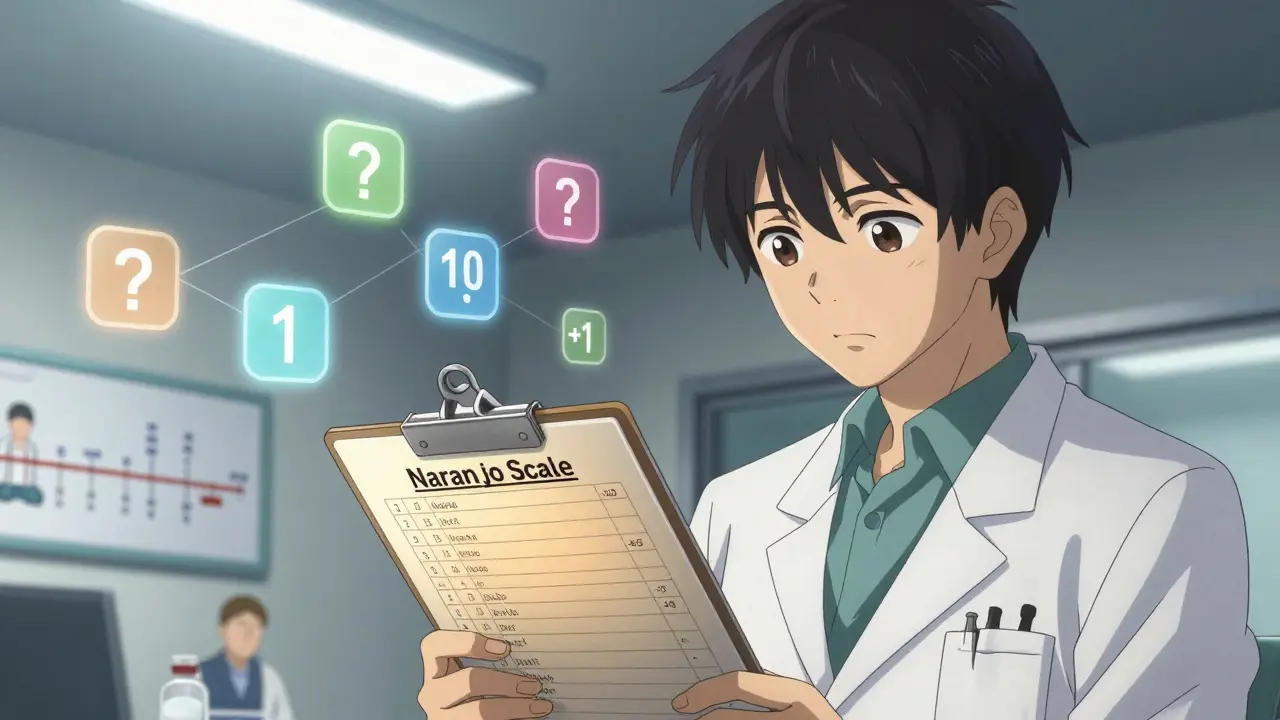
Naranjo Scale Causality Calculator
This interactive tool helps healthcare professionals assess whether an adverse drug reaction was likely caused by a medication using the internationally recognized Naranjo Scale. Answer the 10 questions below to determine causality likelihood.
How the Scale Works
Each question adds or subtracts points. Total score determines causality:
- 9 or higher: Definite
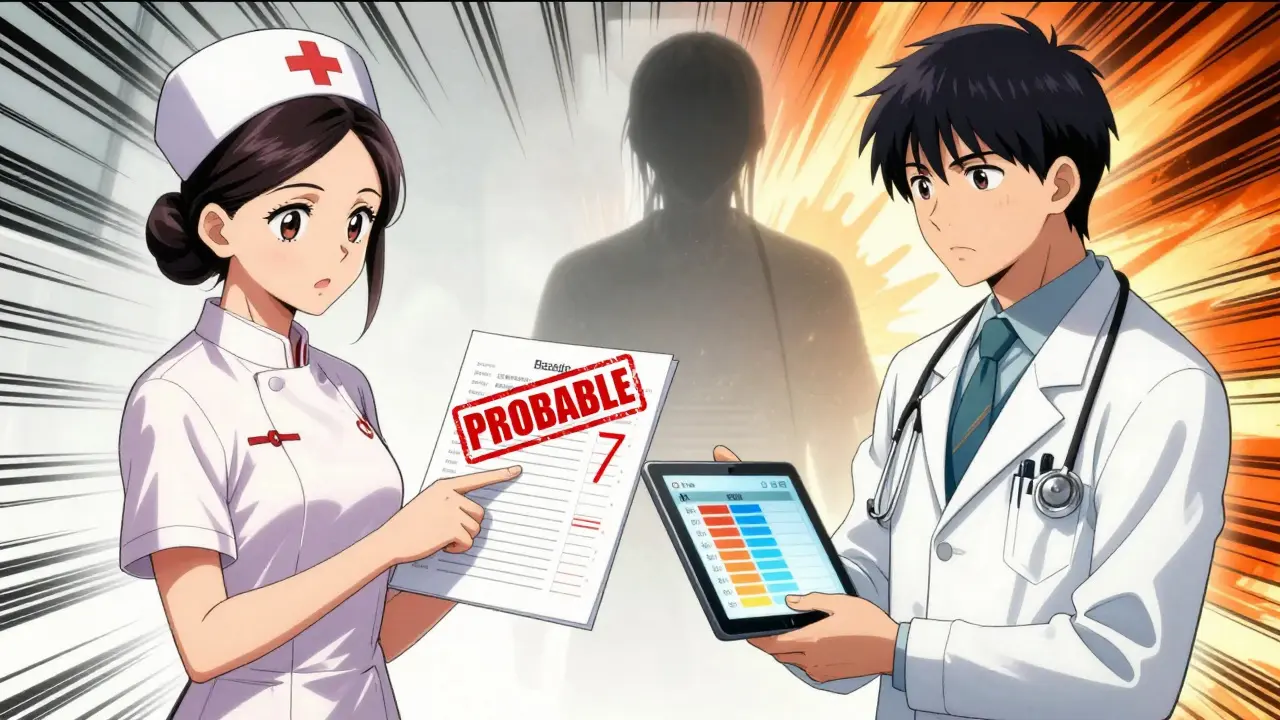
- 5 to 8: Probable
- 1 to 4: Possible
- 0 or lower: Doubtful
Results
When a patient gets sick after taking a new medication, how do you know if the drug actually caused it? It’s not always obvious. Maybe it was the flu. Maybe it was stress. Or maybe it was the antibiotic they just started. This is where the Naranjo Scale comes in. It’s not fancy. It doesn’t need a computer. But it’s one of the most trusted tools doctors and pharmacists use to figure out if a bad reaction was really caused by a drug.
What Is the Naranjo Scale?
The Naranjo Scale is a simple 10-question checklist developed in 1981 by a team of researchers led by Dr. Carlos A. Naranjo. It was created because, after the thalidomide disaster in the 1960s, the world realized drug safety needed better rules. Before this, doctors guessed. Now, they score. Each question adds or subtracts points based on simple yes/no answers. The total score tells you how likely it is that the drug caused the reaction.The scale doesn’t care if you’re a nurse, pharmacist, or resident. You just need to know the patient’s history and what happened after they took the medicine. It turns a hunch into a number. And that number matters - it’s used in hospitals, drug companies, and even by regulators like the FDA to decide if a reaction should be reported.
How the Scoring Works
Here’s how it breaks down. Each of the 10 questions gives you a score: -1, 0, +1, or +2. You add them up. That’s it.- Question 1: Have other reports linked this drug to this reaction before? (+1 if yes)
- Question 2: Did the reaction happen after the drug was started? (+2 if yes, -1 if it happened before)
- Question 3: Did symptoms get better after stopping the drug? (+1 if yes)
- Question 4: Did the reaction come back when the drug was restarted? (+2 if yes, -1 if it got worse)
- Question 5: Could something else have caused it? (-1 if yes, +2 if no)
- Question 6: Was a placebo used to test the reaction? (-1 if yes, +1 if no - though this is rarely done today)
- Question 7: Was the drug at toxic levels in the blood? (+1 if yes)
- Question 8: Did higher doses make the reaction worse? (+1 if yes)
- Question 9: Has the patient had this reaction to the same drug before? (+1 if yes)
- Question 10: Is there objective evidence confirming the reaction? (+1 if yes - like lab results or imaging)
After adding everything up, the score tells you the likelihood:
- 9 or higher: Definite - the drug almost certainly caused it
- 5 to 8: Probable - very likely, but not 100%
- 1 to 4: Possible - could be the drug, but other factors might explain it
- 0 or lower: Doubtful - probably not the drug
Why It’s Still Used Today
You’d think a 40-year-old tool would be outdated. But it’s not. In 2023, a study in Cureus showed that over 78% of published ADR case reports still used the Naranjo Scale. Why? Because it works.It’s objective. It forces you to think through every angle. A nurse in Boston told a Reddit thread: “We use it daily. It stops us from blaming the patient’s age or other meds when it might actually be the new blood pressure pill.”
It’s also built into major systems. The FDA’s Adverse Event Reporting System (FAERS) and the European Medicines Agency’s guidelines both list it as an acceptable method. In North America, 92% of pharmacovigilance teams use it. In hospitals with dedicated drug safety teams, it’s standard procedure.
Where It Falls Short
The Naranjo Scale isn’t perfect. And that’s important to know.First, it doesn’t handle multiple drugs well. Most older patients take five or six medications. If someone gets a rash after starting three new pills, the scale can’t tell you which one did it. That’s why tools like the Liverpool Scale were developed - they’re better for complex cases.
Second, some questions are outdated. Question 6 asks if a placebo was used to test the reaction. But in modern medicine, giving someone a placebo to see if they get sick again? That’s unethical. Most clinicians just mark “don’t know,” which lowers their score and makes the reaction seem less certain than it might be.
Third, it doesn’t account for new kinds of drugs. Biologics, immunotherapies, gene therapies - these can cause reactions months later or have effects that never go away. The Naranjo Scale was built for antibiotics and statins. It wasn’t designed for cancer drugs that trigger immune storms.
And then there’s the human factor. One study found that 35% of doctors disagreed on what counts as a “reasonable alternative cause.” One doctor thinks a UTI explains the fever. Another says no, it’s the new antibiotic. That inconsistency is real.
How People Use It in Practice
In hospitals, the Naranjo Scale is often filled out by pharmacists during daily safety rounds. They review patient charts, talk to nurses, check lab results, and score each suspected reaction. The results go into a database. If five patients on the same drug get the same reaction and all score “probable,” the hospital might issue a warning.Some places have digitized it. A Python-based calculator released in 2023 lets users answer questions on a screen. It auto-scores, flags inconsistencies, and cuts assessment time from 11 minutes to 4.2 minutes. Error rates dropped from 28% to 9%. That’s huge.
Medical students learn it in pharmacology classes. On Fiveable, a free learning platform, nursing and pharmacy students spend hours practicing on case studies. Most say they get it after 3-5 examples. But it’s not just about memorizing the questions - it’s about understanding drug mechanisms. A new grad might miss that a headache after starting a beta-blocker is a known side effect. A seasoned pharmacist knows it right away.

What’s Next for the Naranjo Scale?
It’s not going away. But it’s changing.In 2024, the International Council for Harmonisation proposed replacing Question 6 (placebo challenge) with a question about therapeutic drug monitoring - checking if drug levels in the blood match known toxic ranges. That’s a smart update.
AI is also stepping in. The FDA’s Sentinel Initiative uses machine learning to spot patterns across millions of patient records. It doesn’t need a 10-question form - it finds signals automatically. But it still uses the Naranjo Scale as a benchmark to train its models.
Experts agree: the Naranjo Scale won’t be replaced. It’ll be augmented. Think of it like a flashlight in a dark room. AI is the spotlight. But the flashlight? Still useful when you need to check one corner.
Bottom Line
The Naranjo Scale isn’t magic. It’s not perfect. But it’s reliable, simple, and grounded in real-world evidence. For most cases - especially when one drug is involved - it’s still the best starting point. It turns guesswork into structure. And in drug safety, structure saves lives.If you’re a healthcare worker, learn it. Practice it. Use it. If you’re a patient, understand that when your doctor says, “This reaction is probable,” they didn’t just guess. They scored it. And that score matters.
What is the Naranjo Scale used for?
The Naranjo Scale is used to determine whether an adverse reaction to a medication is likely caused by the drug itself, rather than by other factors like an underlying illness, another medication, or random coincidence. It gives healthcare professionals a standardized, numerical way to assess causality in suspected drug reactions.
How accurate is the Naranjo Scale?
Studies show moderate accuracy, with inter-rater reliability (kappa values) between 0.4 and 0.6. That means two trained professionals usually agree on the score about 70% of the time. It’s not perfect, but it’s far more consistent than relying on clinical judgment alone. Digital tools have improved accuracy further, reducing errors by nearly 70%.
Can the Naranjo Scale be used for any drug?
It works best for traditional small-molecule drugs like antibiotics, blood pressure meds, or painkillers. It’s less reliable for newer therapies like biologics, immunotherapies, or gene treatments, where reactions can appear weeks after stopping the drug or don’t follow classic patterns. For those cases, newer tools like ALDEN or the Liverpool Scale are preferred.
Why is Question 6 about placebo challenges controversial?
Re-administering a drug that caused a serious reaction - even as a placebo - is considered unethical today. Patients shouldn’t be exposed to harm for assessment purposes. Most clinicians now mark this question as “don’t know,” which lowers the total score. Experts are pushing to replace this question with one about therapeutic drug monitoring, which is safer and more relevant.
Is the Naranjo Scale used globally?
Yes. It’s used in 78 of the 152 countries in the WHO’s International Drug Monitoring Programme. Adoption is highest in North America (92%) and Europe (85%), and lower in Africa (63%). Regulatory agencies like the FDA and EMA accept it as a valid method for reporting adverse drug reactions.
Can I use the Naranjo Scale at home?
Technically, yes - the questions are public. But it’s not meant for self-diagnosis. Misinterpreting answers can lead to wrong conclusions. For example, mistaking a viral rash for a drug reaction could cause someone to stop a life-saving medication. Always consult a healthcare provider before making changes to your meds.
How long does it take to learn the Naranjo Scale?
Most healthcare professionals become proficient after 2-4 hours of training and 5-10 supervised assessments. Full mastery typically requires 20-30 real cases. Nurses and pharmacists often learn it faster than physicians because they’re more familiar with medication histories and timelines.
Are there digital tools for the Naranjo Scale?
Yes. Open-source calculators are available on GitHub, and some electronic health record systems like Epic automatically populate 4 of the 10 questions using patient data. These tools cut assessment time by over 60% and reduce scoring errors significantly. Many hospitals now use them as standard practice.


Author
Mike Clayton
As a pharmaceutical expert, I am passionate about researching and developing new medications to improve people's lives. With my extensive knowledge in the field, I enjoy writing articles and sharing insights on various diseases and their treatments. My goal is to educate the public on the importance of understanding the medications they take and how they can contribute to their overall well-being. I am constantly striving to stay up-to-date with the latest advancements in pharmaceuticals and share that knowledge with others. Through my writing, I hope to bridge the gap between science and the general public, making complex topics more accessible and easy to understand.