

When you take a pill, inject a vaccine, or use a medical device, you expect it to be safe, effective, and consistent. That expectation isn’t luck-it’s the result of Current Good Manufacturing Practice (GMP) standards. These aren’t suggestions. They’re legally enforceable rules that keep medicines and medical products from being contaminated, mislabeled, or ineffective. As of 2026, GMP requirements have evolved beyond basic cleanliness into a complex, technology-driven system focused on data, risk, and real-time control. If you work in pharmaceuticals, medical devices, or even food manufacturing, understanding today’s GMP standards isn’t optional-it’s survival.
What Does ‘Current’ Really Mean in GMP?
The ‘C’ in CGMP stands for ‘current.’ That’s not just a word. It’s a mandate. It means you can’t rely on outdated equipment, paper records, or manual checks if better options exist. The FDA first codified these rules in 1978, but since then, they’ve been updated constantly. In 2025, the FDA made it clear: if you’re still using physical sampling for every batch test when in-line sensors could give you real-time data, you’re falling behind. The goal isn’t just compliance-it’s continuous improvement using modern science.The Nine Core Requirements of Modern GMP
Current GMP standards break down into nine non-negotiable areas. Missing one can lead to a warning letter, a shutdown, or worse-a recall that costs millions and destroys trust.- Quality Management: You need a full quality system that touches every step-from raw materials to shipping. It’s not just a department. It’s a culture. The quality unit must have authority to stop production if something’s off.
- Sanitation and Hygiene: Cleanrooms aren’t just cleaned-they’re validated. Airflow, particle counts, and microbial levels are monitored continuously. For sterile products, the EU’s Annex 1 now requires closed isolator systems, not just laminar flow hoods.
- Building and Facilities: Layout matters. You can’t have raw materials next to finished products. Air handling systems must meet ISO 14644-1 Class 5 standards for sterile zones. Environmental monitoring isn’t optional-it’s tracked daily.
- Equipment: Every machine must go through IQ (Installation Qualification), OQ (Operational Qualification), and PQ (Performance Qualification). If you replace a sensor, you requalify. No exceptions.
- Raw Materials: Every batch of active ingredient, solvent, or packaging must be tested for identity and purity. Storage conditions are logged: temperature, humidity, light exposure. If your supplier doesn’t provide a certificate of analysis, you don’t use it.
- Personnel: Training isn’t a one-time event. Staff in cleanrooms get retrained quarterly. Gowning procedures are documented and observed. In the EU, full-body sterile garments are now mandatory for Grade A/B areas.
- Validation and Qualification: Every process-mixing, filling, sterilization-must be proven to work consistently. The FDA’s January 2025 guidance says you can’t rely on models alone. You need real-time data to back them up.
- Complaints and Recalls: If a customer reports a problem, you have 72 hours to start an investigation. Root cause analysis must be complete within 30 days. Recalls must be traceable to the exact batch and production line.
- Documentation and Record Keeping: Everything must be written down, at the time it happens. Electronic records must follow ALCOA+ principles: Attributable, Legible, Contemporaneous, Original, Accurate, and Complete, Consistent, Enduring, Available. No backdating. No erasures. No ‘I’ll write it later.’
FDA vs. EU GMP: Key Differences in 2026
Not all GMP rules are the same. Where you manufacture matters.| Requirement | FDA CGMP (2025) | EU GMP Annex 1 (2024) |
|---|---|---|
| Sampling Method | Allows in-line, at-line, or on-line measurements. No need to remove material. | Still requires physical sampling for critical quality attributes. |
| Sterile Manufacturing | Flexible approach. Accepts isolators or open processing with controls. | Requires closed isolator systems for aseptic filling. |
| Data Integrity | Strict ALCOA+ enforcement. Audit trails mandatory for all electronic records. | Same ALCOA+ rules, but audit trails must be enabled by default on all systems. |
| Personnel Gowning | Requires cleanroom suits, but no explicit full-body sterility mandate. | Full-body sterile garments required in Grade A/B zones. |
| Enforcement Style | Flexible, risk-based. More warning letters for interpretation issues. | Prescriptive. Fewer letters, but higher penalties for violations. |
The FDA gives you room to innovate. The EU gives you a checklist. Both demand the same outcome: no contaminated product reaches patients. But if you’re exporting to both markets, you’re likely running duplicate testing protocols-something that costs an average of $75,000 per year per facility, according to industry surveys.
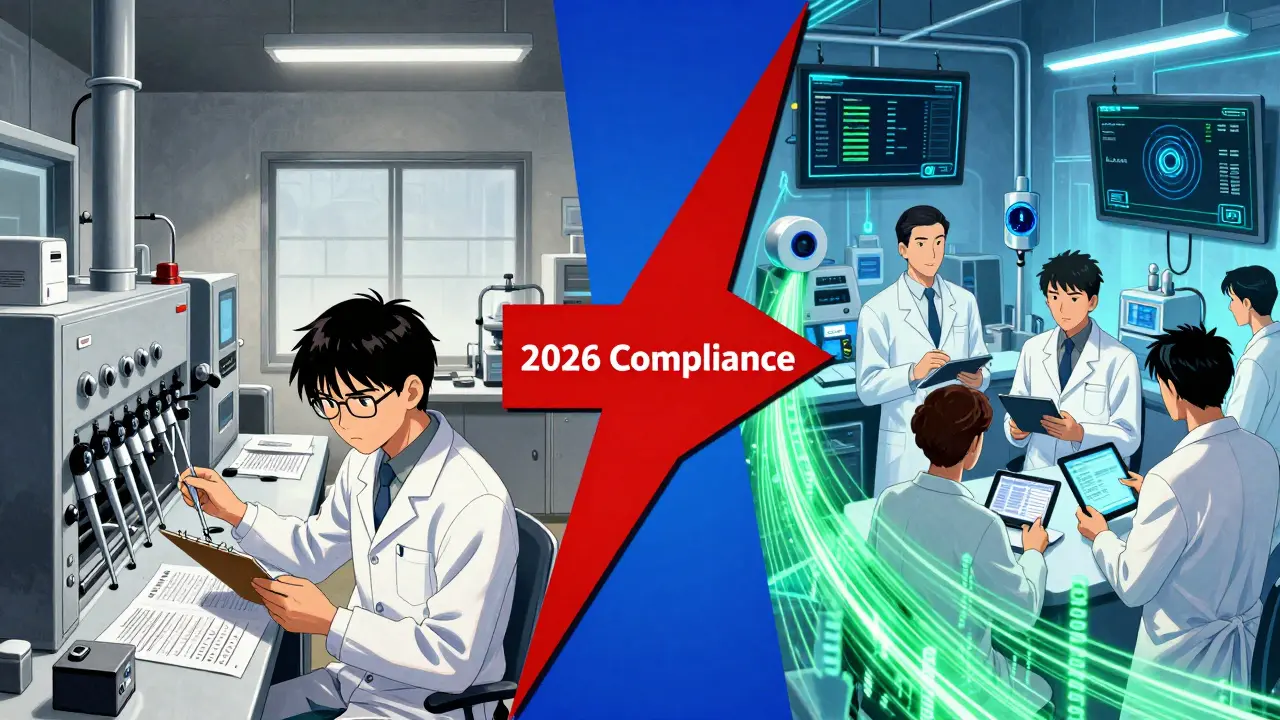
Data Integrity: The #1 Compliance Challenge in 2026
In 2024, 68% of pharmaceutical facilities listed data integrity as their biggest headache. Why? Because paper records are gone. Even if you still have a clipboard, the regulator expects electronic records-and those records must be secure, unchangeable, and traceable.ALCOA+ isn’t a buzzword. It’s the law. Every entry must be tied to a person (Attributable), readable (Legible), made at the time of the event (Contemporaneous), the original record (Original), accurate (Accurate), and complete (Complete). The ‘+’ adds Consistent, Enduring, and Available-meaning your data must survive audits for up to five years after the product expires.
Companies that failed this in 2024 saw 2,147 FDA warning letters. That’s not a typo. That’s more than five per day. The cost to fix it? On average, $185,000 per facility. And it’s not just about software. It’s about culture. If your team thinks ‘I’ll write it down tomorrow,’ you’re already non-compliant.
Advanced Manufacturing Is Now the Norm
GMP isn’t about slowing things down-it’s about making them smarter. Continuous manufacturing, where products flow through a system without stopping, is up 37% since 2023. Process Analytical Technology (PAT), which uses sensors to monitor quality in real time, is up 52%.Merck’s Whitehouse Station facility went from multiple FDA 483 observations to zero in two years by switching to continuous manufacturing with integrated PAT tools. They cut waste by 40%, reduced batch failures by 65%, and cut validation time by half.
But it’s not easy. Integrating sensors into old equipment costs $250,000 per production line. And if you’re using AI to predict quality outcomes, you need to validate the algorithm like you would a machine. The FDA says machine learning models must be documented, tested, and monitored-just like any other critical system. PharmUni’s 2025 report warns that 70% of companies rushing into AI without proper validation will face compliance issues by 2027.

Supply Chain Oversight Is Tightening
In 2024, 18% of product recalls in the EU were linked to poor supplier control. That’s why both the FDA and EMA now require risk-based supplier audits. You can’t just trust a certificate. You need to know where your raw materials come from, how they’re stored, and whether the supplier follows GMP too.WHO’s 2024 report found that 67 low- and middle-income countries still struggle with basic GMP implementation. That’s a global risk. A contaminated active ingredient from one supplier can trigger recalls across continents. In 2026, every manufacturer must map their supply chain like a supply chain map-down to the farm or lab where the ingredient was made.
Implementation Costs and Timeline
Getting compliant isn’t cheap. For a mid-sized pharmaceutical company, full GMP compliance takes 18 to 24 months and costs an average of $1.2 million. That includes:- Upgrading equipment and sensors
- Hiring or training a dedicated compliance team (minimum 3 full-time staff for facilities over 10,000 sq ft)
- Writing 120-150 standard operating procedures (SOPs)
- Training staff for at least 40 hours per year
- Investing in electronic quality management systems
Companies that delay face higher costs. A 2025 survey found that facilities that waited until the last minute to update systems spent 40% more than those who planned ahead. And if you’re caught non-compliant, you could lose your license-or worse, face criminal charges for putting patients at risk.
What’s Next for GMP in 2027?
The trend is clear: GMP is moving toward real-time quality, predictive analytics, and global alignment. By 2027, experts predict FDA, EU, and ICH standards will converge on data integrity and supply chain security. But differences in sterile manufacturing and sampling rules will likely remain.The WHO is pushing for better GMP adoption in developing countries, but without enforcement power, progress is slow. Meanwhile, regulators are watching AI, blockchain for traceability, and digital twins of manufacturing lines. The companies that thrive won’t just comply-they’ll use GMP as a competitive advantage.
If you’re not investing in modern GMP now, you’re not just risking fines. You’re risking your market access, your reputation, and your patients’ safety.
Are GMP standards the same worldwide?
No. While the core principles are similar, the rules vary by region. The FDA allows more flexibility and encourages modern technology like in-line monitoring. The EU is more prescriptive, especially for sterile products under Annex 1. WHO GMP serves as a baseline for developing countries but lacks enforcement power. If you export products, you must meet the standards of every market you sell to.
Can I still use paper records for GMP compliance?
Technically, yes-but it’s risky. The FDA and EMA expect electronic records. Paper records are allowed only if you can prove they’re as reliable as digital ones. Most regulators now assume electronic systems are the norm. Using paper increases the chance of errors, lost data, and audit failures. In 2026, paper is a liability, not a backup.
What happens if I fail a GMP inspection?
You’ll get a Form 483 from the FDA or an inspection report from the EMA listing violations. If serious, you may receive a Warning Letter, which gives you 15 days to respond with a corrective plan. Failure to fix issues can lead to import bans, product seizures, or even criminal charges. In the EU, repeated failures can result in suspension of your manufacturing license.
Do small manufacturers have to follow GMP too?
Yes. GMP applies to all manufacturers, regardless of size. The FDA and EMA don’t make exceptions for small companies. However, they may allow scaled-down documentation if the risk is low. But even small labs making custom formulations must validate their processes, train staff, and keep records. Skipping GMP isn’t an option-it’s illegal.
How often are GMP standards updated?
Constantly. Major updates happen every few years, like the EU’s Annex 1 revision in 2022-2024. But regulators issue guidance documents monthly. The FDA released five major GMP-related guidances in 2025 alone. Companies must monitor regulatory websites and subscribe to alerts. Waiting for an official change notice means you’re already behind.
Is GMP only for pharmaceuticals?
No. GMP applies to medical devices, dietary supplements, food products, and even some cosmetics. The FDA has separate GMP rules for each sector (e.g., 21 CFR Part 111 for dietary supplements). The core idea is the same: ensure safety, identity, strength, and quality. If your product is ingested or used on the body, GMP likely applies.


Author
Mike Clayton
As a pharmaceutical expert, I am passionate about researching and developing new medications to improve people's lives. With my extensive knowledge in the field, I enjoy writing articles and sharing insights on various diseases and their treatments. My goal is to educate the public on the importance of understanding the medications they take and how they can contribute to their overall well-being. I am constantly striving to stay up-to-date with the latest advancements in pharmaceuticals and share that knowledge with others. Through my writing, I hope to bridge the gap between science and the general public, making complex topics more accessible and easy to understand.