

Have you ever noticed how some apps or tools feel natural to use in one country but confusing - even frustrating - in another? It’s not just about language. It’s about culture. And that’s the hidden force behind something called generic acceptance: why people in different parts of the world say yes to the same product, service, or idea - or say no, even when it works perfectly.
Take a simple example: a digital health app that reminds you to take your medication. In Germany, users love it because it’s precise, data-driven, and gives them full control. In Japan, the same app gets ignored - not because it’s broken, but because it doesn’t show social proof. People there don’t trust tools unless they see others using them. In Brazil, the app might be downloaded but rarely used if it doesn’t let users share progress with family. In the U.S., individual control matters most. In Saudi Arabia, gender norms might affect whether a woman feels comfortable using a health tracker designed by a male-led team.
This isn’t random. It’s cultural. And it’s measurable.
Why Culture Determines Whether You Accept Something
For decades, experts assumed that if a product was easy to use and reliable, people would adopt it. That’s the idea behind the Technology Acceptance Model (TAM) - developed in the late 1980s. But it only worked well in places like the U.S., Canada, and Australia. When companies rolled out the same software in India, Mexico, or South Korea, adoption rates dropped - sometimes by half.
The missing piece? Culture.
Geert Hofstede’s cultural dimensions theory, first published in the 1970s, gave us the tools to understand why. He didn’t just look at countries. He looked at patterns in how people think about power, risk, individuality, and time. These aren’t abstract ideas. They shape real behavior.
For example:
- In high uncertainty avoidance cultures - like Greece, Portugal, or Japan - people need detailed instructions, clear rules, and lots of documentation before they trust a new system. Skip that, and they’ll avoid it.
- In collectivist cultures - like China, Nigeria, or Peru - people care more about what their group thinks. If no one in their family or team uses it, they won’t either. Social proof isn’t a nice-to-have; it’s a requirement.
- In long-term orientation cultures - like South Korea or Singapore - users care about sustainability and future benefits. They’ll tolerate a clunky interface if they believe it’ll help them in five years.
- In individualist cultures - like the U.S., Netherlands, or Australia - users want control, customization, and personal results. If the system feels too rigid, they’ll quit.
Research from BMC Health Services Research in 2022 found that these four cultural factors alone explained 37% more variation in health tech adoption than traditional usability metrics. That’s not small. That’s the difference between a 20% adoption rate and a 60% one.
What Happens When You Ignore Culture?
Companies don’t always ignore culture on purpose. Often, they assume their home market is the default. A U.S.-built EHR system gets rolled out in Italy without changes. It works fine on paper. But Italian doctors report it’s "too cold," "impersonal," and "doesn’t fit how we talk to patients." Why? Because Italian healthcare is built on relationships, not just data. The system didn’t account for that.
According to IEEE’s Software Engineering Body of Knowledge, 68% of failed tech implementations in global markets had one thing in common: cultural factors were never considered during design.
Here’s what that looks like in practice:
- A U.S. telehealth platform uses pop-up alerts to remind users to book appointments. In the U.S., that’s helpful. In South Korea, where interruptions are seen as rude, users disable notifications or uninstall the app.
- A fitness app in Sweden lets users track progress privately. In India, users want to share achievements with their WhatsApp group. Without that feature, engagement drops 40%.
- A mental health chatbot in the UK uses direct, clinical language. In Mexico, users respond better to warm, empathetic phrasing - even if it’s less precise.
These aren’t "edge cases." They’re the norm. And ignoring them doesn’t just hurt adoption. It hurts trust.
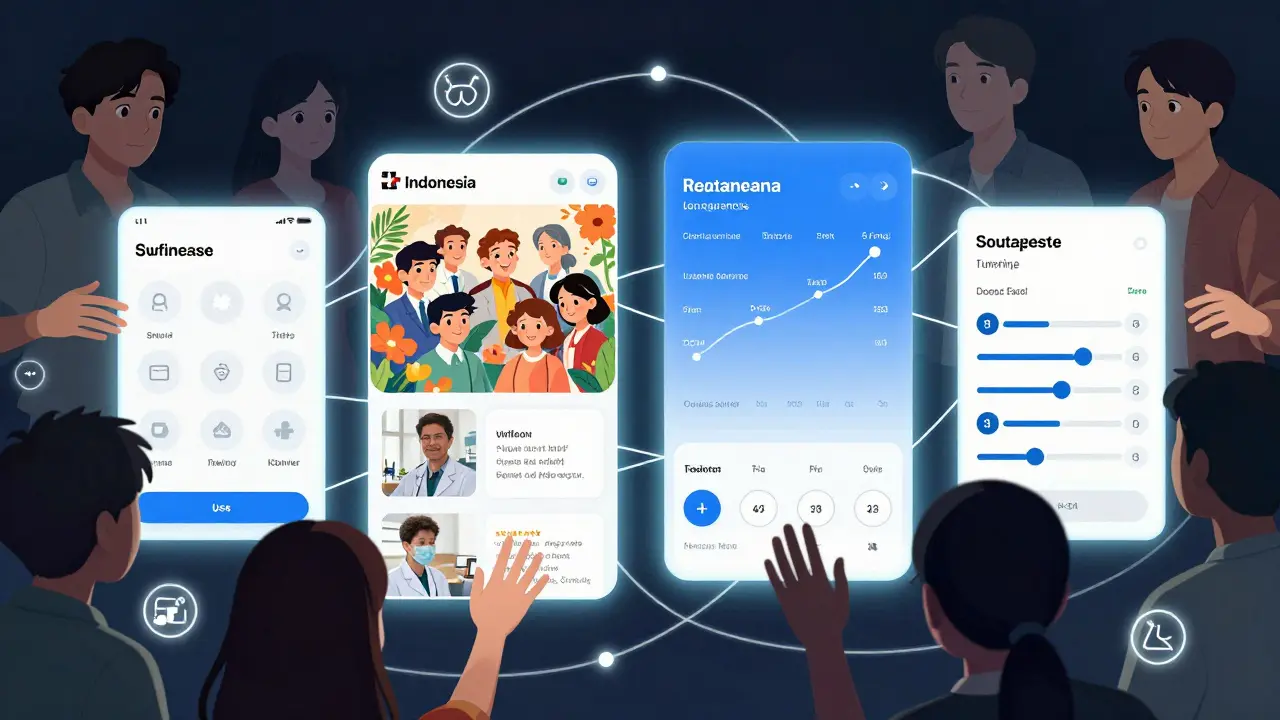
How Culture Changes What "Good" Looks Like
What counts as a "good" user experience isn’t universal. In some cultures, efficiency is king. In others, harmony is more important.
In Switzerland, a medical app that takes three clicks to schedule a test is ideal. Fast, clean, predictable.
In Indonesia, users prefer a five-click process that includes a message from a trusted health worker, a photo of the clinic, and a note saying "many people in your area have used this." They’re not being inefficient. They’re being cautious - and culturally aligned.
That’s why cultural adaptation isn’t about translation. It’s about redesign.
Studies show that when companies adapt interfaces to match local cultural norms, adoption rates jump by 23% to 47%. In one case, a multinational pharmaceutical company saw a 41% drop in user complaints after redesigning their patient portal to reflect local communication styles in 14 countries.
But here’s the catch: adaptation isn’t cheap or fast.
Doing it right takes time. You need to:
- Assess the cultural landscape - using tools like Hofstede Insights or local ethnographic research.
- Identify which cultural dimensions matter most for your product.
- Redesign features, language, visuals, and feedback loops accordingly.
- Test with real users in each market - not just translators.
- Keep updating as cultural norms shift.
That process can add 2-4 weeks to your launch timeline. But skipping it? That adds months of low usage, support tickets, and lost revenue.
The Dark Side of Cultural Models
Not everyone agrees that cultural dimensions are the answer. Dr. Nancy Howell from the University of Toronto warns that treating cultures as boxes can lead to stereotyping. "A 25-year-old woman in Tokyo doesn’t think like the average Japanese person from 1990," she says. "Individual differences within cultures are bigger than the differences between them."
She’s right. Cultural models give you a starting point - not a rulebook. A 30-year-old engineer in Brazil might value independence more than her mother did. A Gen Z user in Brazil might prefer TikTok-style health tips over formal medical content. Culture isn’t static. And rigid models can miss that.
The best approach? Use cultural dimensions as a compass, not a map. They help you ask better questions:
- Do users here need to see others using this before they trust it?
- Do they prefer direct instructions or gentle guidance?
- Are they more worried about making a mistake, or about being left out?
Then, test with real people. Always.

What’s Changing Now - And What’s Coming
By 2026, the game is shifting fast.
AI tools are now being trained to detect cultural cues in real time. Microsoft’s Azure Cultural Adaptation Services, launched in late 2024, can adjust interface tone, layout, and even color schemes based on a user’s location, language patterns, and behavior - without needing a full cultural assessment.
Regulations are catching up too. The EU’s 2023 Digital Services Act now requires platforms with over 45 million users to make "reasonable accommodations" for cultural differences. That means apps can’t just be translated. They have to be adapted.
And the biggest shift? The rise of Gen Z. Their cultural values are changing faster than any generation before. A 2024 MIT study found that Gen Z’s attitudes toward authority, privacy, and social trust are shifting 3.2 times faster than Millennials. That means cultural models built on 2010s data are already outdated.
What works for a 40-year-old in Spain might not work for a 22-year-old in Madrid. And that’s true everywhere.
What You Can Do Today
You don’t need a global team or a $1 million budget to start. Here’s how to begin:
- Look at your top three markets. Use Hofstede Insights (free tier available) to compare cultural scores.
- Ask: Which dimension is most likely to block adoption? Uncertainty avoidance? Individualism? Power distance?
- Find one small feature to test. Maybe it’s the onboarding flow, or the way feedback is requested.
- Run a quick user test with 5-10 people in each market. Don’t ask what they think. Watch what they do.
- Adjust. Measure. Repeat.
Companies that do this don’t just get better adoption. They build deeper trust. And trust? That’s the only thing that lasts longer than a feature update.
Generic acceptance isn’t about making something that works everywhere. It’s about making something that feels right - in every place.
What does "generic acceptance" mean in cultural terms?
Generic acceptance means how willing people are to adopt a product, system, or idea - even when it’s not tailored to their specific needs. In cultural terms, it’s about whether the design, language, and behavior of that product align with local values like trust, authority, individualism, or social connection. A tool can be technically perfect but still rejected if it feels culturally wrong.
How do Hofstede’s cultural dimensions affect technology use?
Hofstede’s five dimensions - like uncertainty avoidance, individualism vs. collectivism, and long-term orientation - shape how people respond to new tools. For example, in high uncertainty avoidance cultures (like Japan), users need detailed instructions and proof of reliability. In collectivist cultures (like Brazil), they need to see others using it. These aren’t preferences - they’re psychological triggers that determine whether someone will even try a product.
Can cultural adaptation really improve adoption rates?
Yes - and by a lot. Meta-analyses show that culturally adapted health and tech tools see adoption increases of 23% to 47%. In one healthcare study, adapting an EHR system to match local communication styles reduced user complaints by 41%. The difference isn’t small. It’s the difference between a product that works and one that’s ignored.
Is cultural adaptation expensive and time-consuming?
It can be - but not doing it is costlier. A full cultural assessment takes 2-4 weeks and adds to upfront costs. But failed implementations due to cultural mismatch cost companies far more: lost revenue, support overload, and damaged trust. Many companies now use AI tools to speed up adaptation, reducing the time to days instead of weeks.
Are cultural models outdated with Gen Z?
Traditional models based on older generations can be misleading. Gen Z’s values - especially around privacy, authority, and social proof - are shifting faster than ever. A 2024 MIT study found their cultural attitudes change 3.2 times faster than Millennials’. That means cultural tools need to be dynamic, not static. Use dimensions as a starting point, but always test with real users from each generation.


Author
Mike Clayton
As a pharmaceutical expert, I am passionate about researching and developing new medications to improve people's lives. With my extensive knowledge in the field, I enjoy writing articles and sharing insights on various diseases and their treatments. My goal is to educate the public on the importance of understanding the medications they take and how they can contribute to their overall well-being. I am constantly striving to stay up-to-date with the latest advancements in pharmaceuticals and share that knowledge with others. Through my writing, I hope to bridge the gap between science and the general public, making complex topics more accessible and easy to understand.