
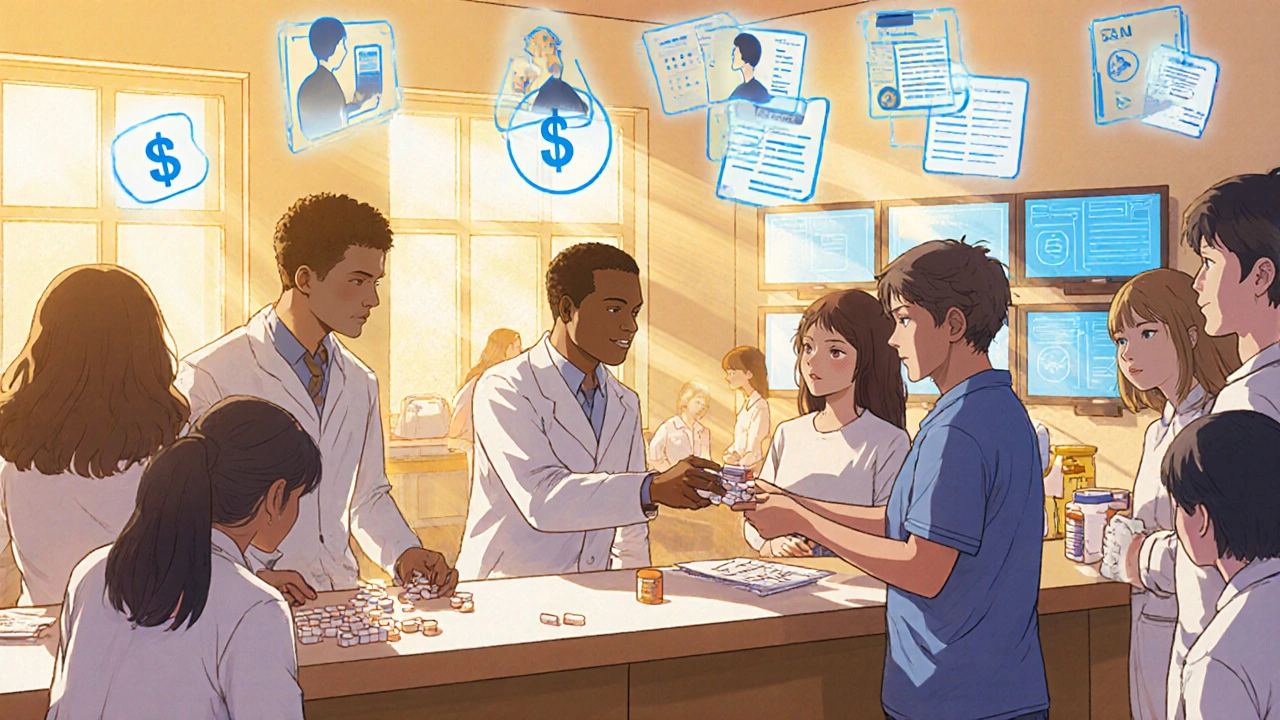
When you pick up a generic pill at the pharmacy, you’re not just saving money-you’re benefiting from a complex, funded system that keeps the FDA moving. Without the generic drug user fees, the FDA wouldn’t have the resources to review thousands of applications each year. This isn’t magic. It’s a carefully designed program called GDUFA, and it’s the reason your generic prescriptions arrive faster, cheaper, and with more reliability than ever before.
What Exactly Is GDUFA?
GDUFA stands for Generic Drug User Fee Amendments. It’s not a tax. It’s not a fine. It’s a legal agreement between the FDA and generic drug makers that lets the agency collect fees to pay for reviewing applications. Before GDUFA started in 2012, it could take over two years just to get a generic drug approved. Many applications sat untouched for months. Patients waited longer for affordable alternatives to brand-name drugs. The system was broken.
Today, thanks to GDUFA, the FDA has a steady budget for its Office of Generic Drugs. About 75% of its funding comes from these user fees. That money pays for reviewers, inspectors, software, and training. It’s not just about speed-it’s about consistency. Companies now know what to expect. The FDA knows how many applications it can handle. And patients get access to life-saving medications faster.
How the Fees Work: Four Types You Need to Know
Generic drug companies pay four kinds of fees under GDUFA III, which runs through 2027. Each one serves a specific purpose.
- Application fees: Every time a company submits an Abbreviated New Drug Application (ANDA), they pay $124,680. That’s a fraction of what brand-name drug companies pay under PDUFA ($3.4 million), but it’s still a major cost for small firms.
- Program fees: Every company with an approved generic drug pays $385,400 per year. This covers the overall cost of running the program, not any single application.
- Facility fees: If your factory makes the active ingredient or the final pill, you pay $25,850 per facility. Even if you only supply one drug, you pay this fee. Small manufacturers hate this part-it can eat up 15% of their annual regulatory budget.
- DMF fees: Drug Master Files (DMFs) contain detailed info about ingredients or manufacturing processes. Each time a DMF is first referenced in an ANDA, the holder pays $25,850.
These fees aren’t optional. If you don’t pay, your application won’t be reviewed. The FDA doesn’t delay or ignore you-they just stop processing until payment clears. Payments go through the FDA’s electronic system, and deadlines are strict: program fees by April 1, facility fees by October 1, and application fees when you submit.
Why These Fees Are a Game Changer
Before GDUFA, the FDA had no consistent funding for generic reviews. They relied only on congressional appropriations, which fluctuated yearly. Reviewers were stretched thin. Applications piled up. In 2011, the average review time was 36 months. By 2021, thanks to GDUFA, that dropped to under 12 months for many cases.
The results speak for themselves. Since GDUFA launched, generic drug approvals have jumped 22% annually. In 2022, the FDA received 1,128 ANDAs-more than 16 times the number of new brand-name drug applications. Without GDUFA, that volume would have crushed the system.
It’s not just about speed. GDUFA forced the FDA to be more transparent. Deficiency letters-those documents that tell you what’s wrong with your application-are now specific and actionable. Before, companies got vague feedback like “insufficient data.” Now, they’re told exactly which section needs more detail, what standard wasn’t met, and how to fix it.
Who Pays the Most? And Who Struggles?
The big players-Teva, Mylan, Sandoz-handle these fees easily. They have dozens of approved drugs and multiple facilities. They spread the cost across their portfolio. But small companies? They feel it hard.
A small generic manufacturer with one facility and three approved drugs pays about $385,400 (program fee) + $25,850 (facility fee) + $374,040 (three application fees) = $785,290 annually. That’s nearly $800,000 just to keep their products on the market. For a startup with $2 million in annual revenue, that’s a huge chunk.
The FDA offers a 75% fee reduction for qualifying small businesses, but only 18 applications were certified in 2022. Why? Many don’t know they qualify. Others find the paperwork too confusing. The system assumes you’re a lawyer or a compliance officer, not a small business owner trying to get a pill approved.
Even worse, the facility fee hits hard if you’re a contract manufacturer. If you supply ingredients to five different companies, you still pay one fee. But if you’re owned by a parent company that owns five other facilities, you might be forced to pay five separate fees-even if you’re the same physical plant.
What’s Still Broken?
GDUFA fixed a lot-but not everything.
First, there’s the backlog. About 1,500 ANDAs submitted before 2012 are still pending. The FDA promised to clear them by September 2024. They’re close, but not done. Many of these applications are outdated, poorly written, or based on old science. Fixing them takes time and resources.
Second, over-the-counter (OTC) drugs are left out. That’s a $117 billion market-think cough syrup, antacids, allergy pills. These drugs don’t need an ANDA, but they still need FDA review under monograph rules. No user fees. No funding. No progress. Experts are pushing to include OTCs in GDUFA IV, but Congress hasn’t acted yet.
Third, market concentration. Even with faster approvals, 20% of generic drug markets have only one or two suppliers. That means no competition. That means higher prices. GDUFA gets drugs to market faster, but it doesn’t force companies to actually sell them. The FTC is watching this closely.
What’s Next? GDUFA IV and Beyond
Negotiations for GDUFA IV are already underway. The FDA wants to use real-world data-like pharmacy sales or patient outcomes-to speed up post-market reviews. That could help catch safety issues faster. But industry groups are worried. Real-world data means more reporting, more cost, more complexity. Will small companies be able to handle it?
Another big idea: expanding GDUFA to cover OTC drugs. The Congressional Budget Office estimates that could bring in $150-200 million a year. That’s enough to hire dozens of new reviewers. It’s also the most logical next step. Why fund prescription generics and not the pills people buy off the shelf every day?
The FDA’s goal? Reduce the ANDA backlog by 50% by 2025. They’re on track. But they also want to cut review times even further-aiming for 12 months for 70% of applications. That’s ambitious. But with GDUFA III’s inspection cycles (every 2 years for pill factories, every 3 for ingredient makers), they’re building a system that doesn’t just review-it monitors.
What This Means for You
If you’re a patient, this system means more choices, lower prices, and fewer shortages. A generic version of a brand-name drug often hits the market within months of patent expiration, thanks to GDUFA. Over the past decade, this has saved U.S. consumers $1.7 trillion.
If you’re a manufacturer, GDUFA is a double-edged sword. It gives you predictability. You know how long reviews take. You know how much you’ll pay. But the fees are high, the rules are dense, and the penalties for mistakes are steep.
If you’re a policymaker or a health advocate, GDUFA proves that industry funding can work-when it’s structured right. It doesn’t buy approval. It buys time, expertise, and transparency. And that’s what patients need most.
Generic drugs make up 90% of all prescriptions in the U.S. but only 23% of drug spending. That’s the power of competition. And GDUFA is the engine that keeps that competition alive.
Frequently Asked Questions
Are generic drug user fees a tax on patients?
No. The fees are paid by drug manufacturers, not patients. The FDA does not charge patients or pharmacies. The cost of these fees is factored into the price of the drug, but because generic drugs compete on price, the overall effect is lower costs for consumers. Studies show that GDUFA has helped drive down prices by speeding up market entry for multiple generic competitors.
Can a small company avoid paying facility fees?
Yes, if they qualify as a small business. The FDA defines a small business as one with fewer than 500 employees and annual revenue under $10 million. Eligible companies can get a 75% reduction on facility and program fees. But the application process is complex, and many small firms don’t apply because they don’t know they qualify-or they’re overwhelmed by the paperwork.
Why do brand-name drugs cost so much more to approve?
Brand-name drugs require full clinical trials to prove safety and effectiveness. Generic drugs only need to prove they’re the same as the brand-name version. That’s why PDUFA fees for brand-name applications are over 27 times higher than GDUFA fees. The FDA spends far more time and resources reviewing new drugs than generics.
What happens if a company doesn’t pay its GDUFA fees?
The FDA won’t review any of their applications. If a facility fee is unpaid, the FDA will not approve any drug that uses that facility. If an application fee is late, the ANDA is not accepted. Payments are mandatory-no exceptions. The FDA tracks this electronically and blocks submissions automatically if fees are outstanding.
Does GDUFA cover all generic drugs?
No. GDUFA only covers prescription generic drugs submitted through ANDAs. It does not cover over-the-counter (OTC) drugs, compounded medications, or biological generics (biosimilars). OTC drugs operate under separate FDA monograph rules, and there’s no user fee system for them yet-though that’s being discussed for the next phase of GDUFA.
How does GDUFA affect drug shortages?
GDUFA helps reduce shortages by making the approval process faster and more predictable. When a brand-name drug’s patent expires, multiple generic companies can submit applications quickly. More approvals mean more suppliers entering the market, which prevents single-source shortages. Since 2012, the number of generic drug shortages has dropped significantly, especially for high-demand medications like antibiotics and heart drugs.
Next Steps for Manufacturers
If you’re a generic drug company, here’s what to do now:
- Check your fee status on the FDA’s electronic user fee system (EUF). Make sure all payments are up to date.
- Use the FDA’s free fee calculator to estimate your annual costs. Don’t guess-calculate.
- Apply for small business fee reductions if you qualify. The paperwork is worth it.
- Attend FDA’s quarterly webinars. They explain changes before they hit you.
- Reach out to the User Fee Office helpdesk (8:30 AM-4:30 PM ET, Mon-Fri). They answer real questions from real companies.
If you’re a patient or advocate, stay informed. Ask your pharmacist: “Is this generic approved under GDUFA?” If they don’t know, it’s time to ask why.


Author
Mike Clayton
As a pharmaceutical expert, I am passionate about researching and developing new medications to improve people's lives. With my extensive knowledge in the field, I enjoy writing articles and sharing insights on various diseases and their treatments. My goal is to educate the public on the importance of understanding the medications they take and how they can contribute to their overall well-being. I am constantly striving to stay up-to-date with the latest advancements in pharmaceuticals and share that knowledge with others. Through my writing, I hope to bridge the gap between science and the general public, making complex topics more accessible and easy to understand.