
When a blockbuster drug’s original patent expires, you’d expect generics to flood the market. But in many cases, they don’t - not because the drug is too complex, but because the company filed a formulation patent on a combination of ingredients that blocks competitors from copying the exact version patients are using.
This isn’t science fiction. It’s standard practice in pharma. Companies like Roche, Genentech, and AstraZeneca have built multi-billion-dollar revenue streams by layering patents on top of each other - not just on the drugs themselves, but on how they’re mixed, packaged, and delivered. These are called formulation patents on drug combinations, and they’re one of the most powerful tools for extending market exclusivity.
What Exactly Is a Formulation Patent on a Drug Combination?
A formulation patent doesn’t protect the active ingredients themselves. That’s covered by the original composition-of-matter patent, which typically expires after 20 years. Instead, a formulation patent protects the specific way those ingredients are combined: the exact milligram ratios, the type of tablet coating, the delivery method (like a subcutaneous injection instead of an IV), or even the timing of when doses are taken.
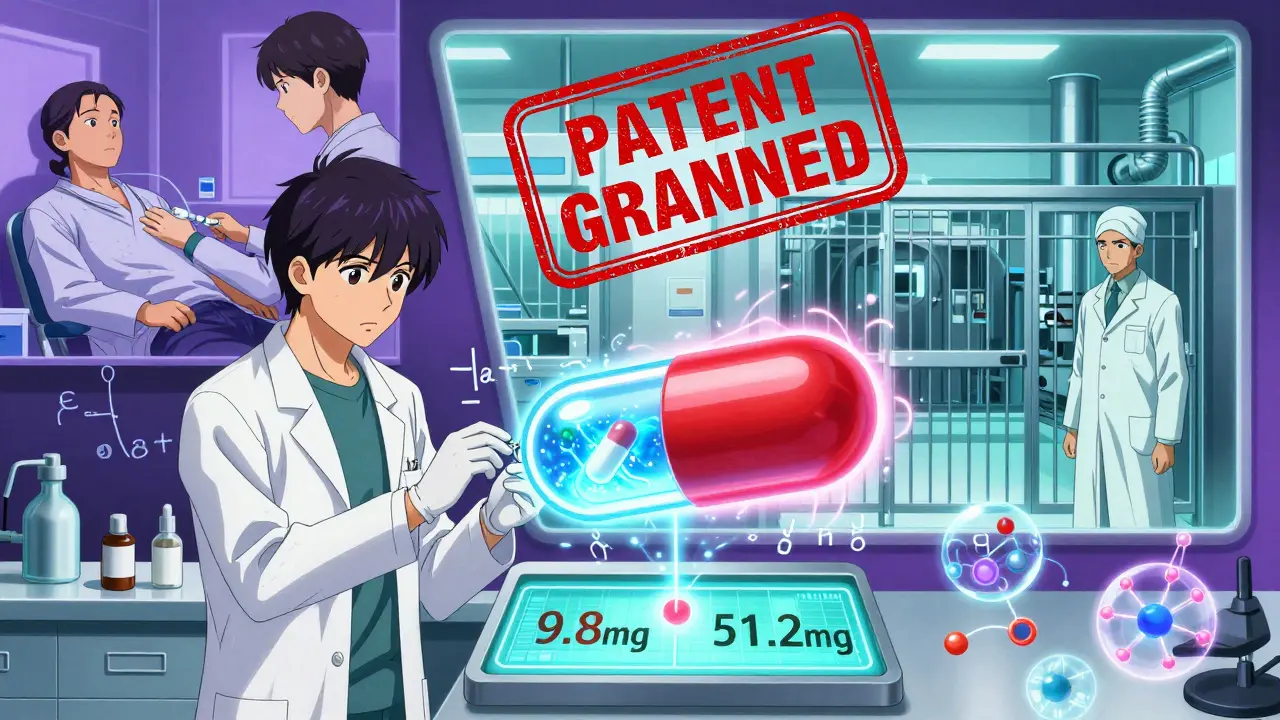
For example, instead of just saying “Drug A and Drug B,” a formulation patent might claim: “A pharmaceutical composition comprising 9.8 mg of Drug A and 51.2 mg of Drug B in a pH-sensitive capsule designed for once-daily oral administration.” That tiny difference - 0.2 mg here, a different coating there - can be enough to stop a generic maker from copying the product without infringing the patent.
The FDA tracks these in the Orange Book, which lists all patents tied to approved drugs. Of the secondary patents filed between 2018 and 2022, 63% were either formulation patents or method-of-use patents - not the original drug patents. These aren’t just minor tweaks. They’re engineered to create barriers.
Why Do Companies Do This?
Developing a new drug costs an average of $2.6 billion and takes 10 to 15 years. Once the core patent expires, revenue can drop by 80% within months as generics take over. Formulation patents let companies delay that crash.
Take Nexium®. The original drug, Prilosec, was losing exclusivity. AstraZeneca didn’t just release a new version - they reformulated it into a more stable, better-absorbed compound, filed a new patent, and rebranded it as Nexium. Even though the active ingredient was nearly identical, the patent gave them 7 more years of market control. That extension generated over $189 billion in revenue.
Another example is Phesgo®, a combination of trastuzumab and pertuzumab in a single subcutaneous injection. Instead of patients needing two separate IV infusions, they get one quick shot. The original patents on the two drugs had expired. But the combination, the dosage, and the delivery device were all new - and patentable. That one formulation patent blocked biosimilars from entering the market for years.
This strategy isn’t just about money. It’s about control. If generics can’t copy the exact formulation, they have to develop their own version. That means new clinical trials, more time, more cost - and often, they never bother.
How Do You Get a Formulation Patent Approved?
It’s not easy. The bar is high. Under U.S. patent law (35 U.S.C. § 103), combining two known drugs for a known purpose is considered “obvious” - unless you can prove it’s not.
Patent examiners demand evidence of “unexpected results.” That means:
- A statistically significant improvement in effectiveness (p < 0.01)
- A major reduction in side effects
- A new delivery method that improves patient compliance
- A formulation that’s more stable or easier to store
One pharmaceutical patent attorney on Reddit noted: “I’ve seen 10mg/50mg get rejected while 9.8mg/51.2mg gets granted - precision matters.” It’s not just about the science. It’s about the exact wording in the claims.
Companies spend $28-42 million extra on R&D just to gather this data. That’s on top of the original drug development cost. They run head-to-head clinical trials comparing their new combination to the old version. If the new one reduces nausea by 40% or cuts administration time from 90 minutes to 5 minutes, that’s the kind of data the USPTO needs.
But even then, rejection rates are high. New companies face a 62% initial rejection rate. Only experienced players like Pfizer and Novartis manage to get over 70% of their formulation patents approved.
What’s the Downside?
For patients and insurers, this strategy drives up drug prices. The FTC estimates that evergreening through minor formulation changes increases U.S. drug costs by 17-23% beyond what innovation justifies.
And it’s not always legitimate. A 2022 study in JAMA Internal Medicine found that 31% of combination patents filed between 2015 and 2022 covered trivial changes - like switching from a salt form to another salt, or changing a filler ingredient - with no clinical benefit.
Some companies use this to force “product hopping.” They discontinue the original drug, push patients onto the new patented version, and make it harder for generics to compete. The FTC has 17 active investigations into this practice as of September 2024.
And it doesn’t always work. In 2021, Mylan successfully challenged Celgene’s Revlimid® patents by targeting non-patented indications. Amgen lost a $147 million legal battle trying to patent a subcutaneous injector for Enbrel® - the court ruled it was just automating a manual process.
Formulation patents have a 38% invalidation rate in court - much higher than the 22% rate for original patents. Courts are getting tougher, especially after the 2007 KSR v. Teleflex decision, which made it harder to patent obvious combinations.
How Long Does This Strategy Last?
On average, formulation patents add 3 to 8 years of exclusivity beyond the original patent. But the range is wide:
- Drugs with weak patent portfolios: 3 extra years
- Strategically fortified products like Humalog insulin: up to 16 years total exclusivity
The FDA also grants regulatory exclusivities that stack on top of patents:
- 5 years for a new chemical entity
- 3 years for a new formulation or indication
- 7 years for orphan drugs
Between 2010 and 2020, 42% of approved drugs received multiple overlapping exclusivities. That’s a patent thicket - layers of protection that make it nearly impossible for generics to enter without risking a lawsuit.
But that’s changing. The FDA proposed new rules in May 2024 requiring “clinical superiority evidence” for any new formulation to qualify for 3-year exclusivity. Congress is also considering the Preserve Access to Affordable Generics Act, which would limit secondary patents to those showing “meaningful clinical benefit.” If passed, it could invalidate nearly 30% of current formulation patents.
Who Benefits? Who Loses?
Pharmaceutical companies win. The global market for formulation and combination patents was worth $312 billion in 2023 - 22% of the total $1.43 trillion pharmaceutical patent market. Top 10 drugmakers average 14.7 formulation patents per blockbuster drug. Mid-sized firms? Just 3.2.
Patients and insurers lose. Drug prices stay high longer. Generic alternatives are delayed. In oncology and rare diseases, where combination therapies are common, this can mean waiting years for cheaper options.
But generics are fighting back. In 2023, generic companies filed 842 Paragraph IV challenges against formulation patents - up from 517 in 2020. And they’re winning more often: 45% of these challenges succeed now, compared to 30% a decade ago.
The Future of Combination Patents
The strategy isn’t dying - it’s evolving. Companies are moving beyond simple mixtures. New patents now cover:
- Predictive dosing algorithms built into auto-injectors
- Smart pills that release drugs based on gut pH
- Fixed-dose combinations with extended-release profiles that last 72 hours
Roche’s 2023 patent for a trastuzumab-deruxtecan combination with pH-sensitive release technology is a sign of the future. It required 2.3 extra years of development - but could extend exclusivity by 8.5 years.
As regulatory pressure grows, companies will need to prove real clinical value - not just legal cleverness. The days of patenting a different color tablet or a slightly different ratio without proof of benefit are ending.
But for now, formulation patents remain the most effective tool in the pharma playbook. They’re expensive, risky, and controversial - but they work. And as long as billions are on the line, companies will keep pushing the boundaries of what’s patentable.


Author
Mike Clayton
As a pharmaceutical expert, I am passionate about researching and developing new medications to improve people's lives. With my extensive knowledge in the field, I enjoy writing articles and sharing insights on various diseases and their treatments. My goal is to educate the public on the importance of understanding the medications they take and how they can contribute to their overall well-being. I am constantly striving to stay up-to-date with the latest advancements in pharmaceuticals and share that knowledge with others. Through my writing, I hope to bridge the gap between science and the general public, making complex topics more accessible and easy to understand.