

More than half of people taking medication for chronic conditions like high blood pressure, diabetes, or asthma miss doses at least sometimes. It’s not laziness. It’s forgetfulness, confusion over complex schedules, or simply being overwhelmed. The result? Hospital visits, worsening health, and billions in avoidable healthcare costs. But there’s a simple, powerful tool most people already carry in their pocket: their smartphone.
Why Medication Adherence Matters More Than You Think
Missing a dose of your blood pressure pill might seem harmless. But over weeks and months, those missed doses add up. Studies show that patients who don’t take their meds as prescribed are 50% more likely to be hospitalized. For conditions like HIV or epilepsy, where adherence needs to be 95% or higher, even one missed dose can trigger serious complications. The World Health Organization calls non-adherence one of the biggest public health problems today. Traditional fixes like pill organizers or paper charts often fail. People forget to refill them. They get lost. They don’t account for changes in dosage. That’s where digital tools step in. Medication timers and apps don’t just remind you-they track, educate, and even connect with your doctor’s system.How Medication Adherence Apps Actually Work
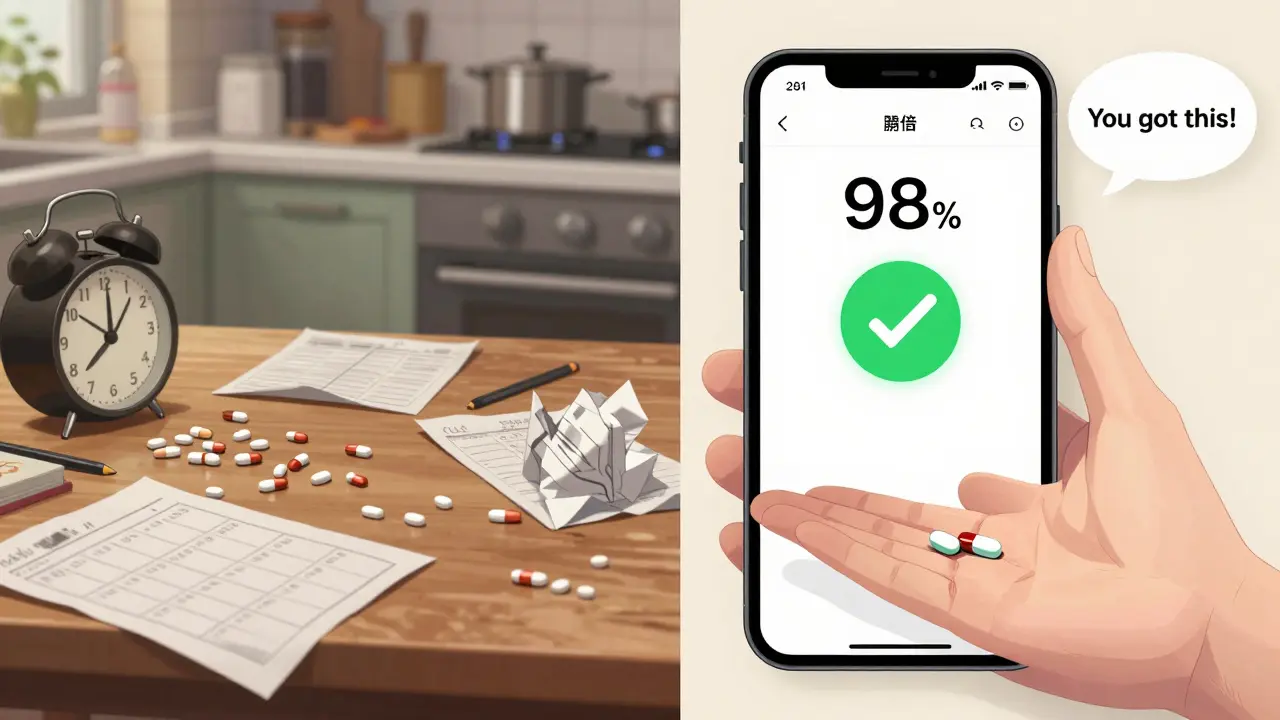
These aren’t fancy gadgets. They’re apps you download like any other. Once installed, you enter your meds: name, dose, time, and frequency. The app then sends a push notification when it’s time to take your pill. Simple? Yes. Effective? Absolutely. But the best apps do more. They log whether you took the dose. They warn you if a new prescription might interact with something you’re already taking. Some show your progress over time with charts. Others let you share reports with family members or your pharmacist. A few even sync with your pharmacy to auto-request refills. According to a 2025 meta-analysis in JMIR, 92% of top adherence apps include customizable reminders. Eighty-seven percent have dashboards that show your adherence rate week by week. That visual feedback matters. Seeing a streak of 14 days taken correctly? That’s motivation. Missing a day? The app nudges you-not with guilt, but with a gentle reminder.Top Features That Make a Difference
Not all apps are created equal. Here’s what actually moves the needle:- Customizable reminders: Set different tones, vibration patterns, or even multiple alerts spaced 15 minutes apart. No more silence when you’re in a meeting.
- Medication log: Automatically records when you take each pill. No manual entry needed if you tap ‘taken’ when you do.
- Drug interaction checker: Enters your full list of meds and flags dangerous combos. This isn’t just a nice-to-have-it’s a safety net.
- Progress tracking: Visual graphs showing your adherence over time. Seeing improvement builds confidence.
- Family access: Let a caregiver get alerts if you miss a dose. Useful for elderly parents or those with cognitive challenges.
- Pharmacy integration: Apps like Medisafe can send refill requests directly to your pharmacy. No more running out because you forgot to call.
Apps vs. Old-School Tools: The Numbers Don’t Lie
You might think a pill box with alarms is enough. But here’s the reality:| Tool | Cost per Month | Adherence Improvement | Additional Features |
|---|---|---|---|
| Basic pill organizer | $10-$25 (one-time) | 0-5% | None |
| Electronic medicine box (e.g., MedMinder) | $30-$50 | 10-15% | Opening sensors only |
| SMS reminders | $0-$5 | 12-18% | No tracking, no education |
| Medication adherence app | $0-$5 (premium) | 22-40% | Tracking, education, alerts, refills, interaction checks |
Who Benefits Most? Real-World Cases
Apps aren’t one-size-fits-all, but they shine in specific situations:- People on multiple daily meds: Someone taking 6 pills at 3 different times? An app turns chaos into clarity.
- Chronic disease patients: Studies show strong results in diabetes, heart disease, and HIV. One Reddit user reported their HbA1c dropped from 8.2 to 6.9 after six months using Medisafe.
- Older adults: Even those over 65 can use these apps with a little help. Setup takes longer-about 42 minutes on average-but once done, usage is high.
- People with low health literacy: Apps with simple language and visual cues help more than dense pamphlets.
Getting Started: No Tech Expert Needed
You don’t need to be a tech whiz. Here’s how to begin:- Download a top-rated app like Medisafe, MyTherapy, or Round Health from your phone’s app store.
- Open the app and tap ‘Add Medication’.
- Enter the name of your pill, the dose (e.g., 10 mg), and the time you take it (e.g., 8 AM and 8 PM).
- Set reminders. Choose a sound you’ll hear-even if you’re watching TV.
- Turn on the ‘Log’ feature so it auto-saves your intake.
- Optional: Link your pharmacy or invite a family member to get alerts.
Privacy and Security: Are Your Meds Safe?
You’re sharing sensitive health info. That’s a valid concern. The best apps use end-to-end encryption and comply with HIPAA standards. Many require biometric login-fingerprint or face ID-to open the app. But not all apps are secure. A 2025 study found only 64% of adherence apps clearly stated their security practices. Stick to well-known names with clear privacy policies. Avoid random apps with vague terms like “free health tracker.” If your doctor’s office uses an electronic health record system, some apps can sync directly with it. That means your provider sees your adherence data-not just your complaints about feeling tired.
What About Cost? Free vs. Premium
Many apps are free. Medisafe, MyTherapy, and others offer core features at no cost: reminders, logs, interaction checks. Premium versions ($4.99/month) add things like:- 24/7 chat support
- Advanced analytics
- Priority refill requests
- Integration with wearable devices
The Future: AI, Voice, and Real-Time Help
The next wave is smarter. In early 2024, Medisafe launched an AI-powered “Adherence Coach” that predicts when you’re likely to miss a dose-based on your past behavior, weather, even your calendar. It then sends a personalized nudge: “You skipped your BP pill on rainy days. Want me to remind you earlier tomorrow?” Google’s testing a voice-activated assistant called ‘Med Buddy’ for late 2025. You’ll just say: “Hey Med Buddy, did I take my insulin?” and it’ll check your log. Pfizer is piloting blockchain systems to verify adherence in clinical trials. That’s not for patients yet-but it shows where the tech is headed: real-time, secure, automated.When Apps Don’t Work-and What to Do Instead
Apps are powerful, but they’re not magic. If you have dementia, severe depression, or no smartphone access, they won’t help. In those cases:- Ask your pharmacist for a blister pack with days and times printed on each dose.
- Use a simple alarm clock with multiple timers.
- Ask a family member to call or text you at pill times.
- Ask your doctor about simplified regimens-fewer pills per day can improve adherence more than any app.
Final Thought: It’s Not About the App. It’s About Your Health.
Medication timers and apps aren’t a cure. They’re a tool. Like a blood pressure monitor or a fitness tracker. Their power comes from how you use them-not from the app itself. If you’re struggling to keep up with your meds, try one. Pick a popular app. Spend 15 minutes setting it up. See how it feels. If you miss a dose, the app won’t judge. It’ll just remind you again tomorrow. And that’s the point.Do medication adherence apps really work?
Yes. Fourteen randomized controlled trials from 2023-2025 show that apps improve medication adherence by 22-40% compared to standard care. They’re especially effective for chronic conditions like diabetes, heart disease, and HIV. Users who stick with the app for more than three months see the biggest gains.
Are these apps free or do I have to pay?
Most top apps like Medisafe and MyTherapy are free to download and use. Basic features-reminders, logs, interaction checks-are included at no cost. Premium versions cost around $5/month and add things like 24/7 support or advanced analytics. You don’t need to pay to get real benefits.
Can older adults use medication apps?
Yes, but setup takes longer-about 42 minutes on average for users over 65, compared to 18 minutes for younger adults. Many seniors succeed with help from family or caregivers. Apps with large buttons, simple language, and voice prompts work best. Some pharmacies even offer free setup assistance.
What if I don’t have a smartphone?
If you don’t own a smartphone, apps won’t help. Instead, ask your pharmacist for a pre-filled blister pack with days and times printed on each compartment. Use a simple alarm clock with multiple timers. Ask a trusted friend or family member to call or text you at your pill times. Simpler systems can be just as effective.
Can these apps connect to my doctor’s records?
Some can. Leading apps like Medisafe support integration with electronic health records (EHRs) using secure standards like FHIR. This lets your doctor see your adherence data without you having to report it manually. Check with your provider or app support to see if your system supports this feature.
Are medication apps safe for my privacy?
The best apps use end-to-end encryption and comply with HIPAA. They require biometric login (face or fingerprint) and don’t share data without permission. But not all apps are secure. Stick to well-known names with clear privacy policies. Avoid random apps with vague terms like “free health tracker.”
Do insurance plans cover these apps?
Some do. As of early 2024, 42.6% of Medicare Advantage plans now cover adherence apps as a supplemental benefit. Private insurers are starting to follow. Check with your plan or ask your pharmacy-they often have lists of approved apps.


Author
Mike Clayton
As a pharmaceutical expert, I am passionate about researching and developing new medications to improve people's lives. With my extensive knowledge in the field, I enjoy writing articles and sharing insights on various diseases and their treatments. My goal is to educate the public on the importance of understanding the medications they take and how they can contribute to their overall well-being. I am constantly striving to stay up-to-date with the latest advancements in pharmaceuticals and share that knowledge with others. Through my writing, I hope to bridge the gap between science and the general public, making complex topics more accessible and easy to understand.