
G6PD Deficiency Risk Assessment Tool
Determine your risk of G6PD deficiency based on ancestry and learn if you should consider testing before taking nitrofurantoin.
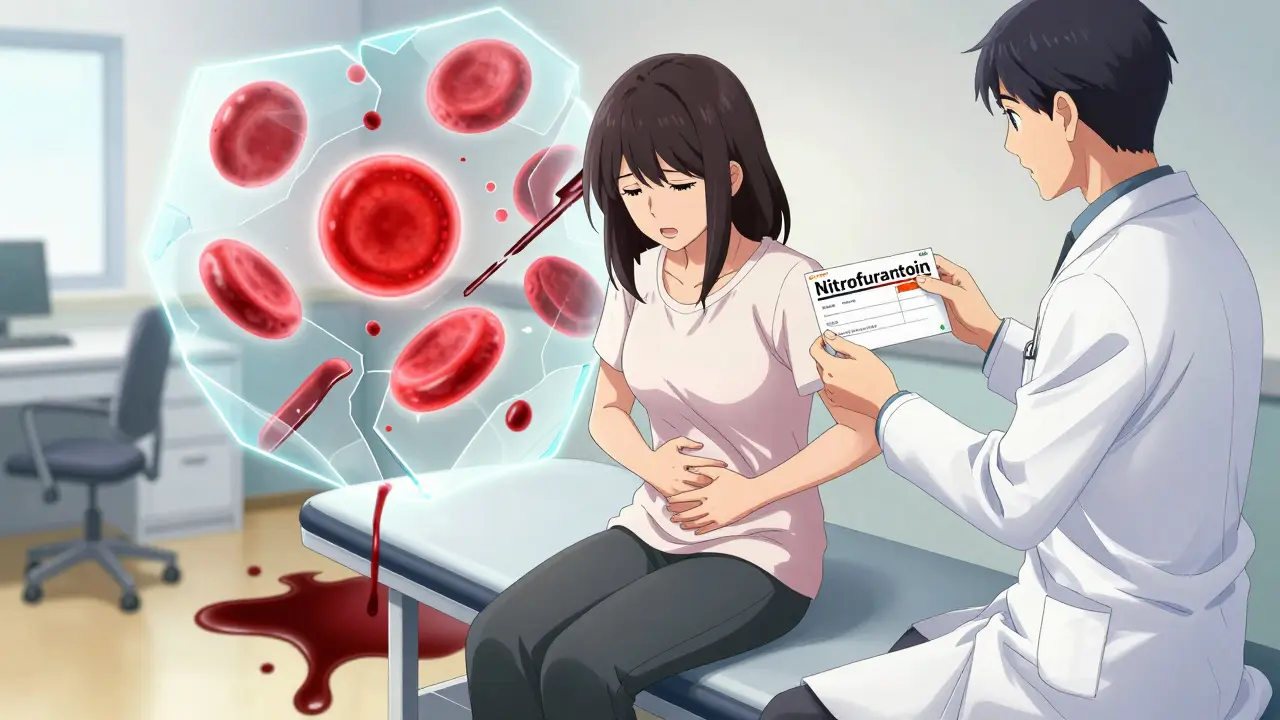
Most people take nitrofurantoin without a second thought. It’s a common antibiotic for urinary tract infections (UTIs), cheap, effective, and often prescribed as a first-line treatment. But for a significant number of people - especially those with undiagnosed G6PD deficiency - this drug can trigger a dangerous, sometimes life-threatening reaction: hemolytic anemia.
What Is Nitrofurantoin, Really?
Nitrofurantoin has been around since the 1940s. It’s sold under brand names like Macrobid and Furadantin. It doesn’t work like most antibiotics. Instead of attacking bacteria all over the body, it concentrates in the urine. That makes it perfect for simple bladder infections, but useless for kidney infections or bloodstream issues. It’s prescribed to about 5.5 million Americans every year, according to FDA data from 2022.
It’s not the strongest antibiotic out there, but it’s one of the few that still works well against common UTI bugs like E. coli. Resistance to trimethoprim-sulfamethoxazole (TMP-SMX) is climbing - up to 25% in some areas - while nitrofurantoin resistance stays below 15%. That’s why doctors keep reaching for it.
What Is G6PD Deficiency?
Glucose-6-phosphate dehydrogenase (G6PD) is an enzyme your red blood cells need to stay healthy. It protects them from oxidative stress - the kind caused by certain drugs, infections, or even fava beans. When you don’t have enough of it, your red blood cells can’t handle the pressure. They break apart too easily. That’s hemolytic anemia.
This isn’t rare. Around 400 million people worldwide have G6PD deficiency, according to the WHO. It’s most common in people of African, Mediterranean, Middle Eastern, and Southeast Asian descent. In Black populations, up to 14% carry the gene. In some parts of the Mediterranean, it’s 4-7%. Most people never know they have it - until something triggers a crisis.
How Nitrofurantoin Triggers Hemolytic Anemia
Nitrofurantoin doesn’t cause an immune reaction. It doesn’t make your body attack its own blood cells. Instead, it creates oxidative stress inside red blood cells. In someone with normal G6PD, the cells produce enough glutathione to neutralize the damage. In someone with G6PD deficiency, they can’t. The hemoglobin inside the red cells starts to clump, the cells get stiff and fragile, and then they burst.
The signs come fast. Within 24 to 72 hours of taking the first dose, you might feel feverish, tired, or nauseous. Your urine turns dark - like cola or tea. Your skin or eyes may look yellow. Your heart races. Your blood pressure drops. In severe cases, you can go into shock.
Lab tests show the classic picture: hemoglobin plummets, bilirubin and LDH spike, haptoglobin crashes, and reticulocytes rise as your bone marrow tries to catch up. One 2023 case report described a patient whose hemoglobin dropped from 13.2 g/dL to 7.1 g/dL in just four days after starting nitrofurantoin. He didn’t need a transfusion - just stopping the drug and IV fluids was enough. But not everyone is that lucky.
The Evidence Is Clear - And Alarming
A 2022 review of medical literature found 42 confirmed or highly probable cases of nitrofurantoin-induced hemolytic anemia in G6PD-deficient patients. Ten of those cases ended in death. Eight involved pregnant women - a group often overlooked in drug safety discussions. Three cases were in infants, two from maternal exposure during pregnancy.
And it’s not just case reports. Pharmacovigilance databases - the systems that track bad drug reactions - show this isn’t a fluke. It’s a pattern. The Clinical Pharmacogenetics Implementation Consortium (CPIC) says it clearly: avoid nitrofurantoin in G6PD-deficient patients, especially if they’ve had chronic hemolytic anemia before.
Even the FDA label warns about it. But here’s the problem: they don’t require testing before prescribing. The warning is buried in fine print. Most doctors don’t screen.
Why Doctors Keep Prescribing It Anyway
A 2022 survey of 350 primary care doctors found only 32% routinely check G6PD status before prescribing nitrofurantoin. Why? Because testing isn’t standard. Because it’s seen as a low-risk drug. Because patients don’t mention their ancestry. Because the test costs $35-$50, and many insurance plans don’t cover it unless there’s a clear reason.
But the cost of not testing is higher. A single hospitalization for hemolytic anemia averages $8,500 to $12,000. That’s 200 times the cost of the test. And if you’re in a high-risk group - African, Mediterranean, or Southeast Asian descent - the risk isn’t theoretical. It’s statistical.
Who Should Get Tested?
If you’re from a population with high G6PD deficiency rates, you should be tested before taking nitrofurantoin. That includes:
- People of African or African American descent
- People from the Mediterranean (Greece, Italy, Turkey, etc.)
- People from the Middle East (Saudi Arabia, Iran, Iraq, etc.)
- People from Southeast Asia (Thailand, Cambodia, Vietnam, Philippines, etc.)
Even if you were born in the U.S. or Australia, if your parents or grandparents came from one of these regions, you’re at risk. And if you’ve ever had unexplained jaundice as a baby, dark urine after taking a drug, or anemia that came out of nowhere - get tested.
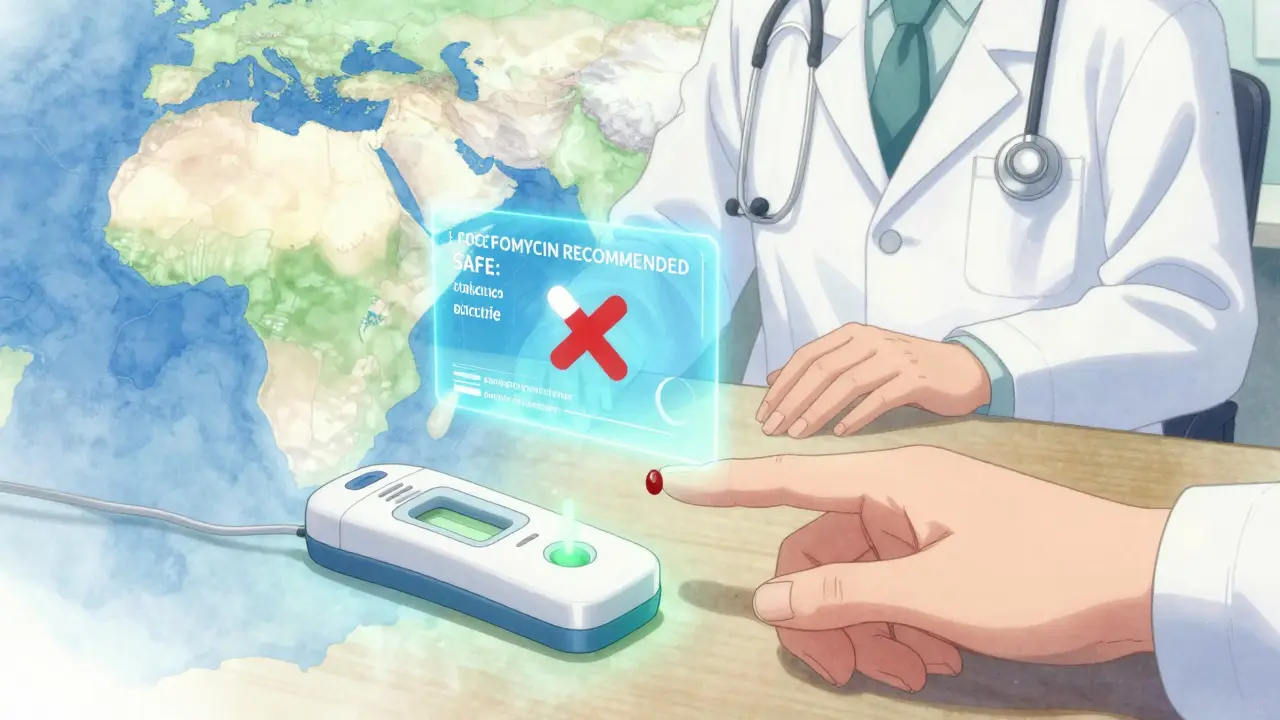
Testing is simple. A quick finger-prick blood test. Results in 15-30 minutes if you’re at a clinic with point-of-care equipment. Most hospitals can do it in a few hours.
What Are the Alternatives?
If you have G6PD deficiency, you don’t need to go without treatment. Safe alternatives for UTIs include:
- Fosfomycin - a single-dose pill. No known hemolytic risk. Works well for uncomplicated UTIs.
- Cephalexin - a first-generation cephalosporin. Generally safe in G6PD deficiency.
- Amoxicillin-clavulanate - if the infection is mild and resistance is low.
- Pivmecillinam - used in Europe, not yet approved in the U.S., but growing in use.
Trimethoprim-sulfamethoxazole (TMP-SMX) is commonly used, but it’s also an oxidant drug. It can trigger hemolysis too. So don’t assume it’s automatically safer. Always check with your doctor.
The Bigger Picture
Pharmacogenetics - how your genes affect your response to drugs - is no longer science fiction. We know now that nitrofurantoin is dangerous for a specific genetic group. We have tests. We have alternatives. We have guidelines from CPIC, the American Society of Hematology, and the EMA.
Yet, in 2026, millions of people still get this drug without knowing their risk. Why? Because the system doesn’t require it. Because testing isn’t built into the workflow. Because it’s easier to prescribe than to pause and ask.
But if you’re from a high-risk background, you owe it to yourself to ask: Have you checked my G6PD status? If the answer is no, ask for the test. It takes five minutes. It could save your life.
What If I Already Took It?
If you’ve taken nitrofurantoin and feel unwell - fever, dark urine, yellow skin, extreme fatigue - stop the drug immediately and seek medical help. Don’t wait. Hemolysis can progress fast. But if caught early, recovery is usually complete within 48-72 hours after stopping the medication. No long-term damage. No need for transfusions in most cases.
And if you took it and felt fine? That doesn’t mean you’re safe. You might still be G6PD deficient. You just got lucky this time. The next dose could be the one that triggers the crisis.
What’s Changing?
Point-of-care G6PD tests are getting cheaper and faster. Some clinics in the U.S. and Australia now offer them during the same visit as a UTI diagnosis. The NIH is running a multi-center trial to see if universal screening before nitrofurantoin is cost-effective. Early results suggest it is.
Electronic health records are starting to flag high-risk patients. If your chart shows African or Mediterranean ancestry, some systems now pop up a warning: “Consider G6PD testing before prescribing nitrofurantoin.”
But until that’s standard everywhere, the responsibility falls on you.
Can nitrofurantoin cause hemolytic anemia in people without G6PD deficiency?
Rarely. Most cases of nitrofurantoin-induced hemolytic anemia occur in people with G6PD deficiency. While there are isolated reports of hemolysis in people with normal G6PD, these are extremely uncommon and often linked to other risk factors like severe kidney disease, high doses, or pre-existing blood disorders. The overwhelming majority of serious cases involve G6PD deficiency.
Is G6PD testing covered by insurance?
It depends. In the U.S., Medicare and many private insurers cover G6PD testing if it’s ordered for a specific clinical reason - like before prescribing nitrofurantoin. But if you’re asymptomatic and just asking for a test, coverage may be denied. Always check with your provider. In Australia, Medicare covers the test under certain conditions, especially if you’re from a high-risk ethnic group. Costs range from $35 to $50 out-of-pocket if not covered.
Can I take nitrofurantoin if I have G6PD deficiency but never had a reaction before?
No. G6PD deficiency is a genetic condition - your risk doesn’t change based on past reactions. Just because you took it once without issues doesn’t mean you’re safe. Oxidant drugs like nitrofurantoin can trigger hemolysis unpredictably. Even mild stress - like an infection or dehydration - can make your red cells more vulnerable. The safest choice is to avoid it entirely.
Does nitrofurantoin affect newborns if the mother has G6PD deficiency?
Yes. Nitrofurantoin can cross the placenta and enter breast milk. There are documented cases of newborns developing hemolytic anemia after maternal exposure - even if the mother never had symptoms. If you’re pregnant or breastfeeding and have G6PD deficiency, avoid nitrofurantoin. Fosfomycin or cephalexin are safer options during pregnancy and lactation.
How do I know if I’m at risk for G6PD deficiency?
You’re at higher risk if you or your ancestors are from Africa, the Mediterranean, the Middle East, or Southeast Asia. If you’ve ever had unexplained jaundice as a baby, dark urine after taking medication, or sudden anemia with no clear cause, you should get tested. Even if you don’t know your ancestry, if you’re from a high-prevalence region or have a family history of anemia, ask your doctor about screening.
Is there a cure for G6PD deficiency?
No. G6PD deficiency is a genetic condition - you’re born with it and you’ll have it for life. But it’s not a disease. Most people live normally. The key is avoiding triggers: certain drugs (like nitrofurantoin, sulfonamides, primaquine), fava beans, and severe infections. With awareness and prevention, you can avoid complications entirely.


Author
Mike Clayton
As a pharmaceutical expert, I am passionate about researching and developing new medications to improve people's lives. With my extensive knowledge in the field, I enjoy writing articles and sharing insights on various diseases and their treatments. My goal is to educate the public on the importance of understanding the medications they take and how they can contribute to their overall well-being. I am constantly striving to stay up-to-date with the latest advancements in pharmaceuticals and share that knowledge with others. Through my writing, I hope to bridge the gap between science and the general public, making complex topics more accessible and easy to understand.