

More than 1 in 10 people claim they have a "sulfa allergy." But here’s the truth: sulfonamide allergies are often misunderstood - and that misunderstanding can put your health at risk. You might think if you had a rash from an antibiotic like sulfamethoxazole, you can’t take any pill with "sulfa" in the name. That’s not true. And avoiding the wrong medications because of a mislabeled allergy could be costing you better treatment - or even putting you on riskier drugs.
What Exactly Is a Sulfonamide Allergy?
When people say they have a "sulfa allergy," they usually mean they had a reaction to an antimicrobial sulfonamide - drugs like sulfamethoxazole (often paired with trimethoprim as Bactrim), sulfadiazine, or sulfacetamide. These are antibiotics used for urinary tract infections, ear infections, and even to prevent pneumonia in people with weakened immune systems. But here’s the twist: only about 0.3% to 0.5% of the population actually has a true IgE-mediated allergy to these drugs. The rest? Most had a mild rash, a stomach upset, or a fever that had nothing to do with an immune reaction. A 2022 study in the Journal of Allergy and Clinical Immunology found that 85% of people who say they’re allergic to sulfa drugs aren’t truly allergic at all. The problem? Doctors take those labels seriously. If your chart says "sulfa allergy," you’re 78% more likely to get a different antibiotic - even if that alternative is broader-spectrum, more expensive, or carries worse side effects. In fact, patients labeled with "sulfa allergy" are 2.4 times more likely to get fluoroquinolones like ciprofloxacin - drugs with black box warnings for tendon rupture and aortic aneurysm.The Big Myth: All "Sulfa" Drugs Are the Same
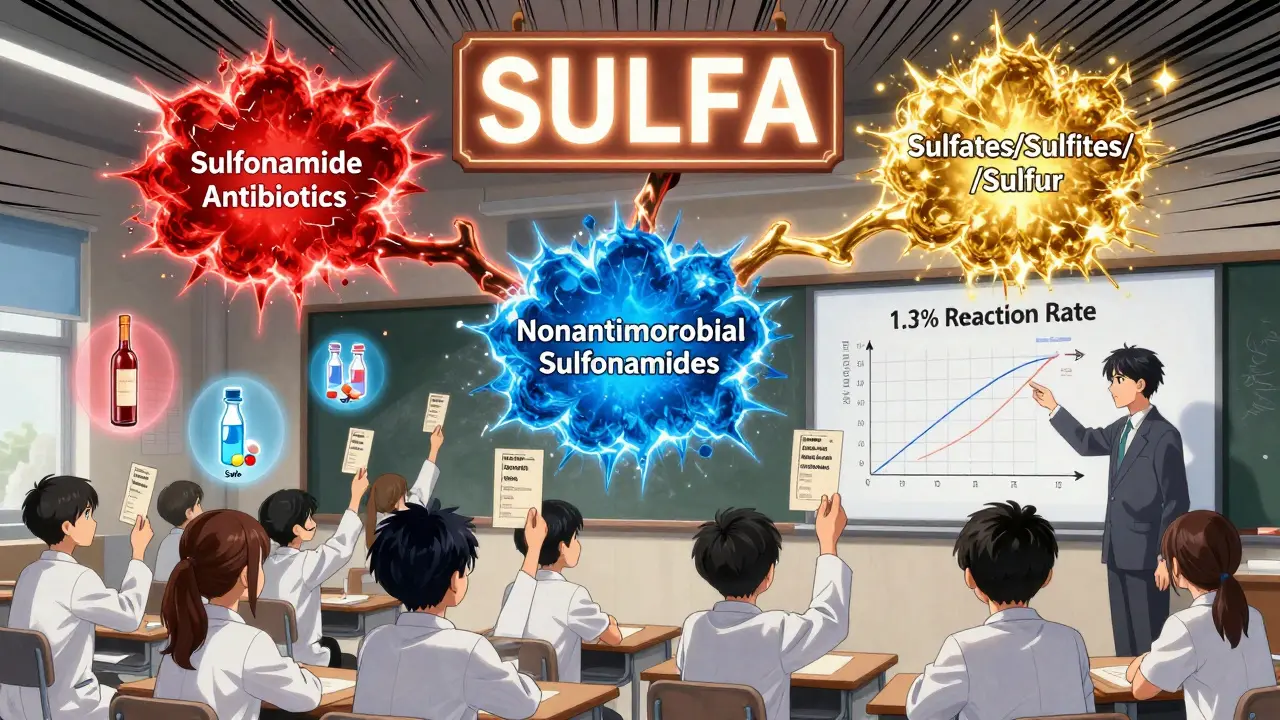
Here’s where most people get tripped up. "Sulfa" doesn’t mean one thing. There are two completely different kinds of sulfonamides:- Antimicrobial sulfonamides - antibiotics like sulfamethoxazole, sulfadiazine, sulfacetamide. These have a specific chemical structure: an arylamine group at the N4 position and a nitrogen-containing ring at N1. This is what triggers allergic reactions in rare cases.
- Nonantimicrobial sulfonamides - drugs like hydrochlorothiazide (for high blood pressure), furosemide (a water pill), celecoxib (Celebrex), and acetazolamide (for glaucoma or altitude sickness). These lack the arylamine group. They’re chemically different. And they don’t cross-react.
What You Can Actually Take - And What to Avoid
Let’s cut through the confusion. If you’ve been told you have a "sulfa allergy," here’s what you need to know:Safe - No Cross-Reactivity
These medications are not cross-reactive with antimicrobial sulfonamides:- Hydrochlorothiazide (HCTZ) - common blood pressure pill
- Furosemide (Lasix) - used for fluid retention
- Celecoxib (Celebrex) - arthritis pain reliever
- Acetazolamide (Diamox) - for glaucoma or altitude sickness
- Metolazone - another diuretic
Use Caution - Possible Cross-Reactivity
One exception: dapsone. It’s used to prevent Pneumocystis pneumonia in people with HIV and treat certain skin conditions. It shares the arylamine structure with antimicrobial sulfonamides. Studies show about 13% of people with a true sulfonamide antibiotic allergy react to dapsone. If you’ve had a severe reaction like Stevens-Johnson syndrome to an antibiotic, talk to an allergist before taking dapsone.What’s Completely Safe - Even If You’re Allergic
Don’t confuse sulfonamides with:- Sulfates - like magnesium sulfate (used in labor) or glucosamine sulfate
- Sulfites - preservatives in wine, dried fruit, or some injectables
- Sulfur - the element itself
Real-Life Consequences of Mislabeling
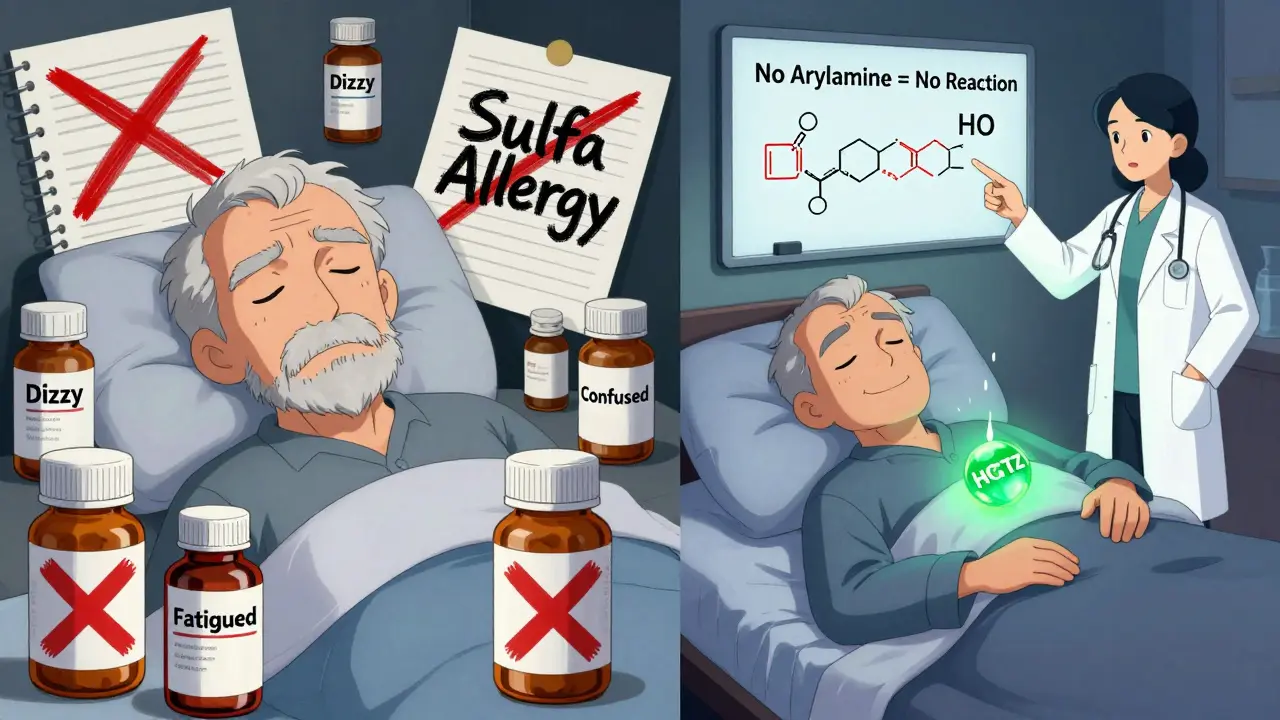
A 68-year-old man in Ohio spent 15 years without hydrochlorothiazide because his chart said "sulfa allergy" from a childhood rash. He ended up on three other blood pressure meds that made him dizzy, fatigued, and confused. When an allergist did a supervised challenge, he took HCTZ with no issue. His blood pressure stabilized. His energy returned. Another case: A woman with HIV needed to take sulfamethoxazole to prevent pneumonia. Her doctor refused because she had a mild rash 20 years ago. She ended up hospitalized with a severe infection. After a graded challenge under supervision, she tolerated the drug perfectly. She’s been healthy for three years since. Reddit threads are full of similar stories. One user wrote: "My doctor refused to prescribe hydrochlorothiazide for 10 years. I was on a diuretic that made me urinate 10 times a night. I finally saw an allergist - turned out I was never allergic. I’ve never slept better."What Should You Do?
If you’ve been told you have a "sulfa allergy," here’s what to do next:- Check your records. What exactly happened? Was it a rash? When? Did you have swelling, trouble breathing, or blistering? A mild rash that showed up five days after starting an antibiotic is likely not an allergy.
- Ask for clarification. Don’t let your chart say "sulfa allergy." Have it updated to say: "Mild maculopapular rash 7 days after sulfamethoxazole-trimethoprim in 2015." Specifics matter.
- Consider an allergist. If you had a severe reaction - like Stevens-Johnson syndrome, toxic epidermal necrolysis, or anaphylaxis - see an allergist. They can do skin testing or a graded oral challenge. Studies show over 94% of people with "sulfa allergy" pass these tests.
- Don’t assume. If you need a diuretic, a painkiller, or a glaucoma med, don’t refuse it just because it has "sulf" in the name. Ask your doctor: "Is this an antimicrobial sulfonamide?" If not, it’s likely safe.
The Bigger Picture
Mislabeling sulfa allergies isn’t just bad for individuals - it’s a public health issue. A 2022 analysis estimated that inappropriate avoidance of sulfonamide antibiotics costs the U.S. healthcare system $1.2 billion a year. Why? Because doctors reach for broader-spectrum antibiotics - which fuel antimicrobial resistance. The CDC reports that when "sulfa allergy" labels lead to the use of alternatives, resistance rates in common bacteria like E. coli and Staphylococcus aureus jump by up to 13%. That means more infections that don’t respond to treatment. More hospitalizations. More deaths. New tools are emerging. The SULF-RISK score - developed in 2022 - uses patient history to predict true allergy risk with 92% accuracy. And by 2025, most major health systems will have automated alerts in their electronic records that flag when a "sulfa allergy" label might be wrong.Final Thoughts
You don’t need to live in fear of every drug with "sulfa" in the name. Most people who think they’re allergic aren’t. And even if you had a reaction, it doesn’t mean you can’t take life-saving or life-improving medications. The real danger isn’t the drug - it’s the myth. Question your label. Talk to your doctor. Get clarity. You might be avoiding a perfectly safe medicine - and putting yourself at greater risk than you realize.Can I take hydrochlorothiazide if I have a sulfa allergy?
Yes. Hydrochlorothiazide is a nonantimicrobial sulfonamide and does not cross-react with antimicrobial sulfonamide antibiotics like sulfamethoxazole. Studies show the risk of reaction is no higher than in people without any sulfa allergy history - about 1% or less. Many patients with documented "sulfa allergies" safely take hydrochlorothiazide after evaluation.
Is celecoxib (Celebrex) safe for someone with a sulfa allergy?
Yes. Celecoxib is a nonantimicrobial sulfonamide. It lacks the arylamine group that causes allergic reactions in antimicrobial sulfonamides. Multiple studies, including one in JAMA Internal Medicine with over 10,000 patients, show no increased risk of reaction to celecoxib in people with sulfonamide antibiotic allergies.
What’s the difference between sulfa, sulfate, and sulfite?
They’re chemically unrelated. Sulfa (sulfonamide) refers to drugs with a specific chemical structure used in antibiotics and some other medications. Sulfates (like magnesium sulfate) are salts used in medicine and supplements. Sulfites are preservatives found in wine and dried fruit. Having a sulfa allergy does not mean you’re allergic to sulfates or sulfites - and there’s no biological link between them.
I had a rash from sulfamethoxazole. Does that mean I’m allergic?
Not necessarily. A mild rash that appears more than 72 hours after starting the drug is often a non-allergic side effect, not a true IgE-mediated allergy. True allergies involve immediate reactions - hives, swelling, trouble breathing - usually within minutes to hours. If your reaction was a mild rash on day 5, you’re likely not allergic. Talk to an allergist to confirm.
Should I get tested for a sulfa allergy?
If you had a mild reaction, you probably don’t need testing - but it can help you avoid unnecessary restrictions. If you had a severe reaction like blistering skin or anaphylaxis, testing is recommended. Graded oral challenges under medical supervision are safe and accurate, with over 94% of patients tolerating nonantimicrobial sulfonamides after testing.


Author
Mike Clayton
As a pharmaceutical expert, I am passionate about researching and developing new medications to improve people's lives. With my extensive knowledge in the field, I enjoy writing articles and sharing insights on various diseases and their treatments. My goal is to educate the public on the importance of understanding the medications they take and how they can contribute to their overall well-being. I am constantly striving to stay up-to-date with the latest advancements in pharmaceuticals and share that knowledge with others. Through my writing, I hope to bridge the gap between science and the general public, making complex topics more accessible and easy to understand.