
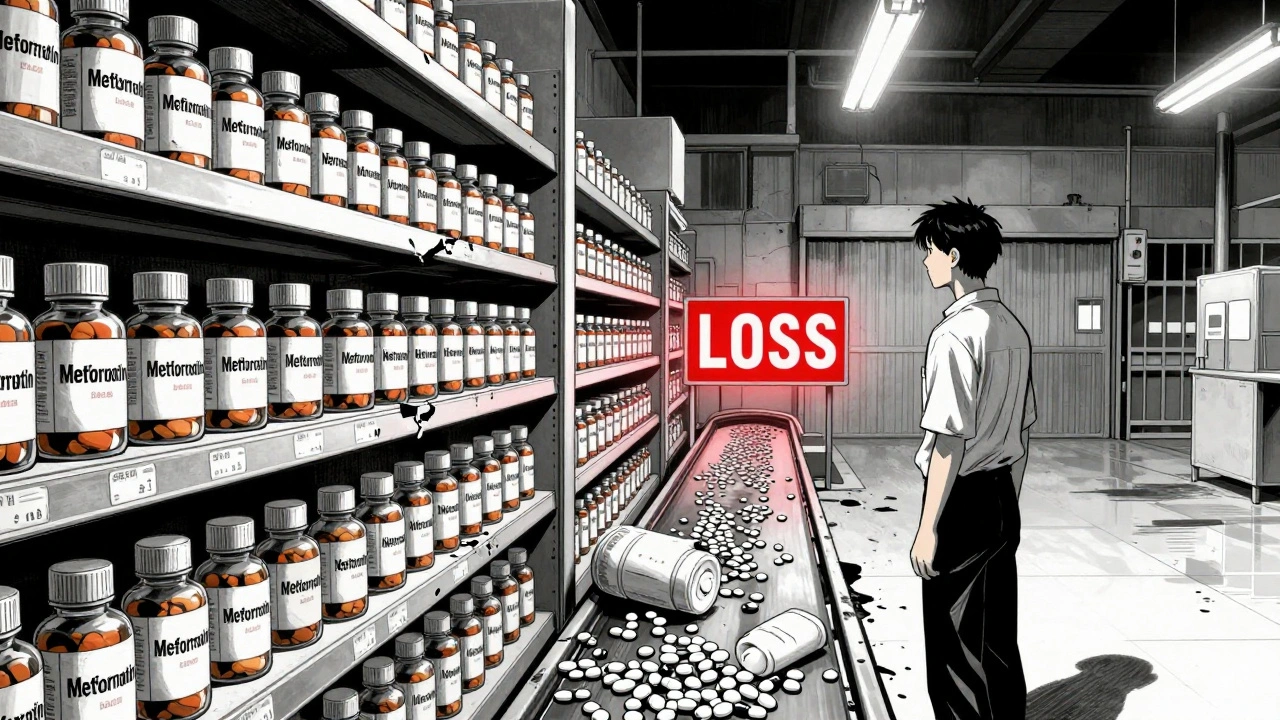
Generic drugs make up 90% of prescriptions filled in the U.S., but they only cost 10% of what brand-name drugs do. That sounds like a win for patients - and it is. But behind that number is a quiet crisis: generic manufacturer profitability is collapsing. Companies that once made decent money producing simple, off-patent pills are now losing money. Some are shutting down. Others are barely surviving. How did this happen? And more importantly, how are some still staying in business?
The Price Collapse That No One Saw Coming
In the early 2000s, generic drug makers could count on 50-60% gross margins. Today, for the simplest drugs - like metformin or lisinopril - margins are often below 30%. Some are down to 10%. Why? Because when a patent expires, dozens of companies jump in. The first to market gets a small premium. The rest? They fight over pennies. Take the case of doxycycline, an antibiotic used for everything from acne to Lyme disease. In 2015, one manufacturer sold it for $20 a bottle. By 2023, the same bottle was selling for $1.50. That’s not inflation. That’s a 92% price drop. And it didn’t stop there. By 2025, some distributors were buying it for under $1. Manufacturers were paying more to package and ship it than they were earning from the sale. This isn’t an accident. It’s the result of a system designed to drive prices down - and it worked too well. Pharmacy benefit managers (PBMs), bulk buyers, and government programs all pushed for the lowest possible price. No one asked if the manufacturer could still afford to make it.The Two Types of Generic Manufacturers
Not all generic drug makers are the same. There are two main types: those stuck in the commodity game, and those who’ve moved up the value chain. The first group - commodity generics - produces easy-to-make pills: tablets, capsules, syrups. These are the drugs with dozens of competitors. They require little R&D. But they also offer almost no pricing power. Companies in this space are trapped. They can’t raise prices. They can’t reduce costs enough. And if one plant shuts down because it’s unprofitable, the whole supply chain risks shortage. That’s what happened with injectable corticosteroids in 2023. No one was making them profitably. Hospitals ran out. Patients were delayed. The second group - complex generics - makes drugs that are hard to copy. These include inhalers, injectables, topical creams, and combination products. Think of a patch that releases medicine slowly over days. Or a liquid that needs perfect viscosity to work. These aren’t just pills. They’re engineering challenges. And because they’re hard to replicate, there are fewer competitors. That means better margins - sometimes 40-60%. Companies like Teva and Viatris are shifting toward these. Teva now makes a version of lenalidomide, a cancer drug with a complex delivery system. It’s not just copying the brand. It’s solving a formulation puzzle. And because only three other companies can make it, they can charge more.The Rise of Contract Manufacturing
Another path out of the profitability trap? Don’t make your own brands. Make other people’s. Contract manufacturing organizations (CMOs) produce generic drugs for other companies - including big pharma, startups, and even generic brands that don’t have their own factories. This segment is growing fast. It’s expected to hit $91 billion by 2030, up from $57 billion in 2025. Why? Because building a cGMP-compliant factory costs over $100 million. Most small companies can’t afford it. But a CMO? They already have the equipment, the permits, the staff. They can make dozens of different products for different clients. That spreads the risk. It also means they’re not competing on price for the same drug. They’re competing on reliability and speed. Egis Pharmaceuticals launched its contract division in late 2023. Now they make APIs (active pharmaceutical ingredients) for partners across Europe and North America. They don’t sell under their own name. They don’t need to. They just need to deliver on time, every time.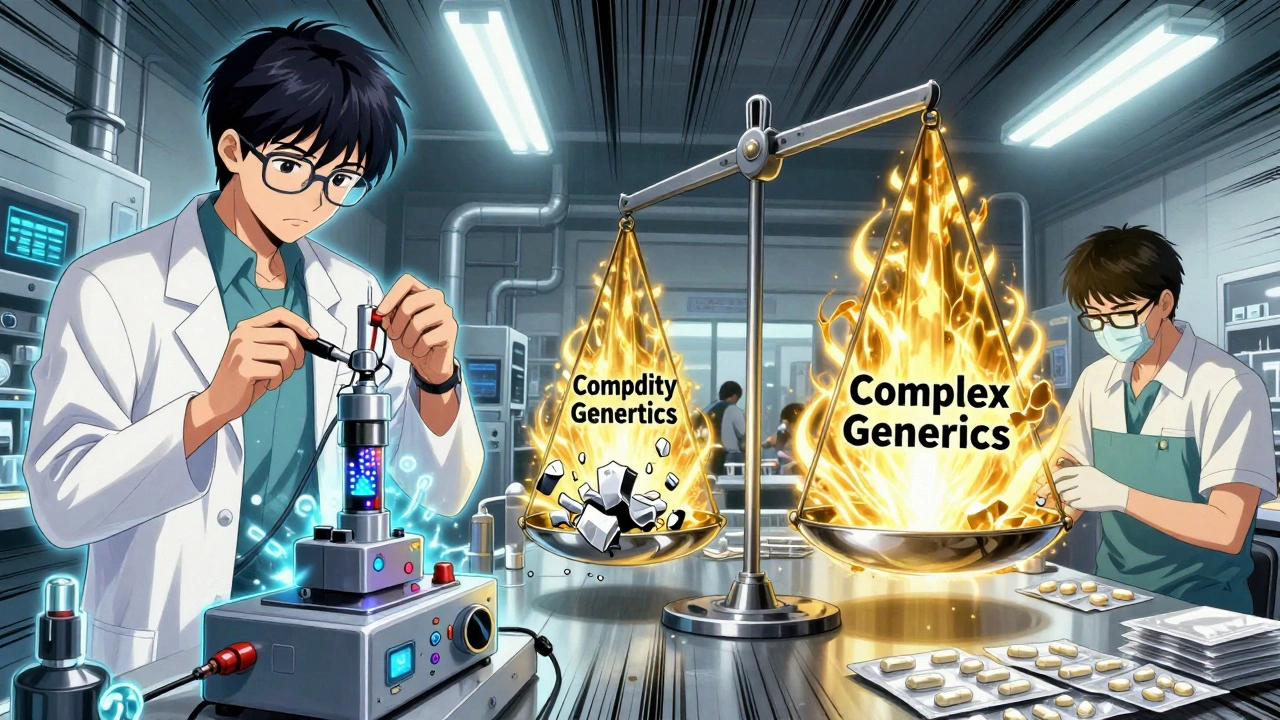
Why Some Are Losing Money - And Others Are Not
Look at the numbers. In 2025, Teva lost $174 million. That’s a negative 4.6% margin. But Mylan (now part of Viatris) made $5.4 million on $125 million in revenue. That’s a 4.3% margin. What’s the difference? Teva spent years chasing volume - making thousands of simple generics. They had factories in 20 countries. They tried to be everything to everyone. That led to bloated costs, overlapping products, and too many low-margin items. Viatris took the opposite approach. After merging with Upjohn in 2020, they sold off their biosimilars unit, their OTC division, and their API business. They kept only what was profitable: established generic brands with stable demand and decent margins. They cut costs. They focused. And now, despite a shrinking market, they’re growing revenue slightly. It’s not about being bigger. It’s about being smarter.The Hidden Costs No One Talks About
Making a generic drug isn’t just about mixing powder and pressing pills. There are hidden costs that eat into profits. First, FDA approval. Each ANDA (Abbreviated New Drug Application) costs about $2.6 million. That’s not a one-time fee. It’s the cost of studies, testing, documentation, and inspections. If your application gets rejected - and 30% do - you lose that money and start over. Second, compliance. cGMP (current Good Manufacturing Practices) isn’t optional. If your factory doesn’t meet FDA standards, you can’t sell. Upgrading a plant to meet those rules can cost $50-150 million. That’s a huge barrier for small players. Third, supply chain. Raw materials like APIs often come from India or China. Prices swing wildly. A shortage of a single chemical can shut down production for months. And if you’re making a drug that’s already priced at $0.50 a pill? You can’t just raise the price to cover the cost spike.The Future: More Consolidation, Fewer Players
The industry is consolidating. In 2014, M&A deals in the generic space totaled $1.86 billion. By 2016, that jumped to $44 billion. Today, a handful of companies control most of the market. New entrants? They’re rare. And when they do show up, they usually fail. McKinsey found that over 65% of companies focusing only on commodity generics fail within two years. Why? They can’t afford the upfront costs. They can’t compete on price. And they don’t have the scale to absorb supply chain shocks. The winners? They’re either going deep into complex generics, or they’re becoming contract manufacturers. Or they’re moving overseas - where labor is cheaper and regulations are less strict. India and China now produce over 70% of the world’s generic APIs.
Is This Sustainable?
Here’s the real question: if no one makes a drug profitably, will it still be available? Dr. Aaron Kesselheim at Harvard put it bluntly: “The relentless price competition in generics has created a market failure.” He’s not talking about profit. He’s talking about access. When a drug becomes unprofitable, manufacturers stop making it. Patients go without. That’s already happening with antibiotics, chemotherapy agents, and even insulin. The Association for Accessible Medicines argues that the market will rebound. They point to dozens of blockbuster drugs set to lose patent protection between 2025 and 2033 - drugs like Humira, Enbrel, and Lantus. That could bring $600 billion in new generic sales by 2033. But here’s the catch: those drugs are complex. They’re not pills. They’re biologics. Making them requires advanced technology, specialized labs, and years of development. Only a few companies can do it. The rest? They’ll be left behind.What Does This Mean for Patients?
You might think, “If generics are cheaper, why should I care who makes them?” Because when manufacturers go bankrupt, drugs disappear. When factories close, supply chains break. When there’s only one company left making a drug, they can raise prices - and they will. The system was built to save money. But it didn’t account for human behavior. Companies will leave a market that doesn’t pay. And when they do, patients pay the price - in delays, in shortages, in worse health outcomes. The answer isn’t to stop making generics. It’s to make them sustainable. That means paying a fair price for complex drugs. It means supporting manufacturers who invest in quality. It means recognizing that cheap isn’t always better - if it means no one can make it at all.Final Thought: Profitability Isn’t the Enemy - Short-Term Thinking Is
Generic drugs are one of the most successful cost-saving tools in modern healthcare. But you can’t squeeze a business to death and expect it to keep feeding you. The future belongs to those who understand this: sustainable profitability isn’t about maximizing short-term margins. It’s about ensuring that essential medicines are always made - by someone, somewhere - at a price that keeps the lights on. The choice isn’t between cheap and expensive. It’s between reliable and unavailable.Why are generic drug profits falling so fast?
Generic drug profits are falling because once a patent expires, dozens of manufacturers enter the market, driving prices down through competition. For simple drugs like antibiotics or blood pressure pills, margins have dropped from 50-60% in the 2000s to under 30% today - sometimes below 10%. Pharmacy benefit managers and government buyers push for the lowest possible price, leaving manufacturers with little room to cover rising production, compliance, and supply chain costs.
Can generic manufacturers still make money?
Yes - but only if they move beyond simple pills. Companies that focus on complex generics - like inhalers, injectables, or combination drugs - still earn healthy margins (40-60%) because fewer competitors can make them. Others are shifting to contract manufacturing, producing drugs for other brands without competing on price. Teva and Viatris are examples of companies that survived by leaving low-margin commodity drugs behind.
What’s the difference between commodity and complex generics?
Commodity generics are simple, off-patent drugs like metformin or amoxicillin - easy to copy, with dozens of makers, and razor-thin margins. Complex generics are harder to produce: think patches, nasal sprays, or injectables with precise delivery systems. These require advanced formulation skills, more testing, and specialized equipment. Fewer companies can make them, so competition is lower - and margins stay higher.
Why do some generic drugs go out of stock?
When a generic drug becomes unprofitable, manufacturers stop making it. If only one company produces it and they shut down, the drug disappears. This has happened with antibiotics, chemotherapy drugs, and insulin. The FDA estimates that over 100 drugs faced shortages in 2024 because no one could make them profitably - even though they were essential.
Is contract manufacturing the future of generic drugs?
Yes, it’s one of the fastest-growing parts of the industry. Contract manufacturers (CMOs) produce drugs for other companies without needing to sell under their own brand. This reduces risk - they serve multiple clients, spread costs across products, and don’t compete on price. The global CMO market is expected to grow from $57 billion in 2025 to $91 billion by 2030. Companies like Egis and Patheon are expanding into this space because it’s more stable than selling low-margin generics directly.
Will new companies enter the generic drug market?
Very few. The barriers are too high. Starting a generic drug company requires $100 million+ in factory investment, $2.6 million per FDA application, and 18-24 months to get approved. McKinsey found that over 65% of new entrants focused on simple generics fail within two years. The market is now dominated by a few large players who can afford the costs and navigate the complexity. New entrants are mostly niche players targeting complex generics or contract manufacturing.


Author
Mike Clayton
As a pharmaceutical expert, I am passionate about researching and developing new medications to improve people's lives. With my extensive knowledge in the field, I enjoy writing articles and sharing insights on various diseases and their treatments. My goal is to educate the public on the importance of understanding the medications they take and how they can contribute to their overall well-being. I am constantly striving to stay up-to-date with the latest advancements in pharmaceuticals and share that knowledge with others. Through my writing, I hope to bridge the gap between science and the general public, making complex topics more accessible and easy to understand.