
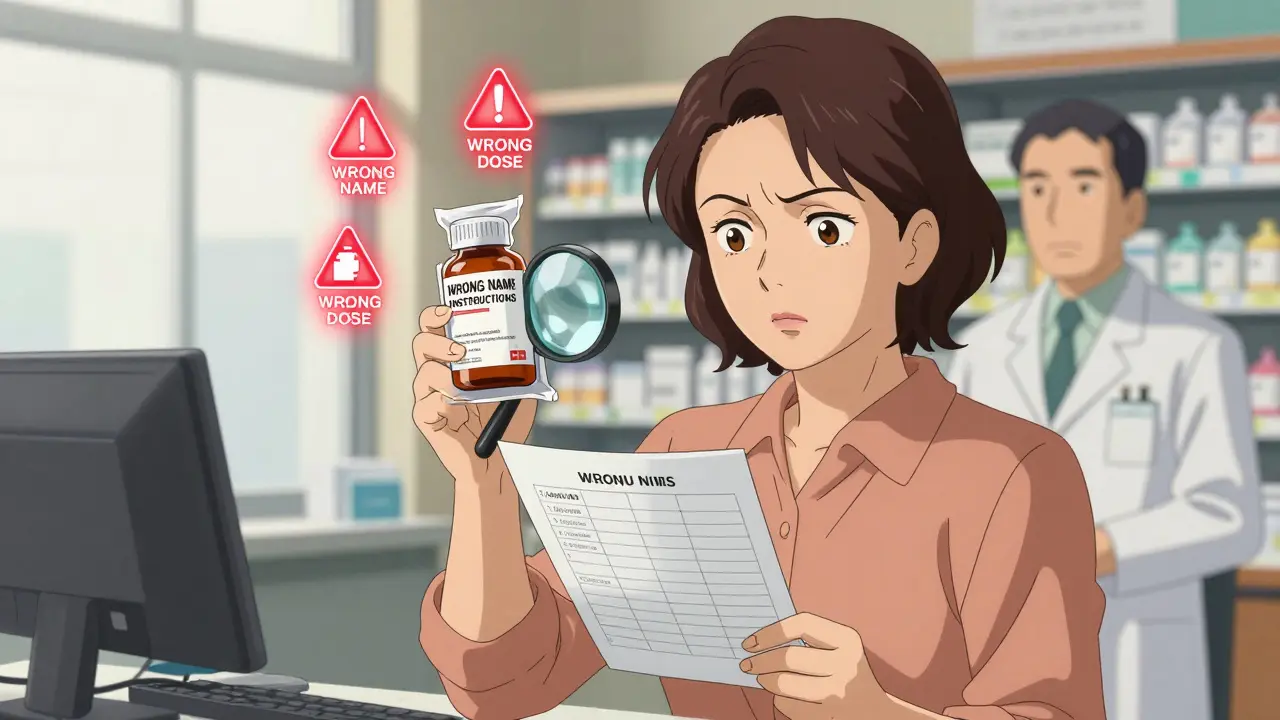
Every year, over a million people in the U.S. get the wrong medication, wrong dose, or wrong instructions - not because of a doctor’s mistake, but because the pharmacy handed them the wrong pill. And here’s the scary part: 87% of these errors are caught by the patient - if they take just 30 seconds to check before walking out. This isn’t about trusting the pharmacy. It’s about protecting yourself.
Why You Need to Audit Your Medication Bag
Pharmacists are trained professionals. They double-check scripts. They use barcodes. They run safety alerts. But humans make mistakes. A name that looks like yours. A pill that looks like another. A label that says "5 mg" when it should be "50 mg." These aren’t rare glitches. According to the Institute for Safe Medication Practices, dosage strength errors alone cause over one-third of serious medication mistakes. And the most common error? Wrong patient. That’s right - someone with a name like "John Smith" might get your prescription. It happens more often than you think.The pharmacy’s final check isn’t your final check. Your eyes. Your hands. Your brain - that’s the last line of defense. And it’s free. No app. No cost. Just seven simple things to look for before you leave.
The 7-Point Medication Audit Checklist
You don’t need a medical degree. You don’t need a magnifying glass (though one helps). You just need to ask these seven questions out loud as you hold your bag:- Is the name on the label YOURS? Not "John Smith," not "J. Smith," not "Jenny Smith." It must match your legal name exactly. A 2024 National Community Pharmacists Association audit found 12.7% of errors were due to similar names. If the label says "J. Lee" and you’re "Janet Lee," that’s a red flag.
- Does the medication name match your prescription? Is it supposed to be "Lisinopril" or "Zestril"? Some pills have brand and generic names. Check your prescription slip or your doctor’s note. The FDA logged over 1,800 incidents in 2023 of look-alike, sound-alike mix-ups - like "Hydralazine" vs. "Hydroxyzine." One letter, one sound, one deadly mistake.
- Is the dosage number and unit correct? This is the most dangerous error. "5 mg" vs. "50 mg" is a tenfold difference. "10 mL" vs. "10 drops" is another. Look for "mg," "mcg," "mL," "units." If it just says "take 5," that’s incomplete. Ask the pharmacist to clarify. A 2023 ISMP report found that 32% of serious errors were dosage-related.
- Is the quantity right? If your doctor prescribed 30 pills, you should get 30 pills. Not 28. Not 35. CMS data shows 8.3% of errors involve incorrect pill counts. Count them. If it’s a bottle, check the label. If it’s a blister pack, make sure all the days are there.
- Is the expiration date at least 6 months away? Medications don’t suddenly turn toxic the day after their expiration date, but they do lose strength. For chronic conditions - blood pressure, diabetes, thyroid - you need full potency. USP guidelines say pills degrade over time. If the expiration is in 3 months, ask if they have a fresher batch.
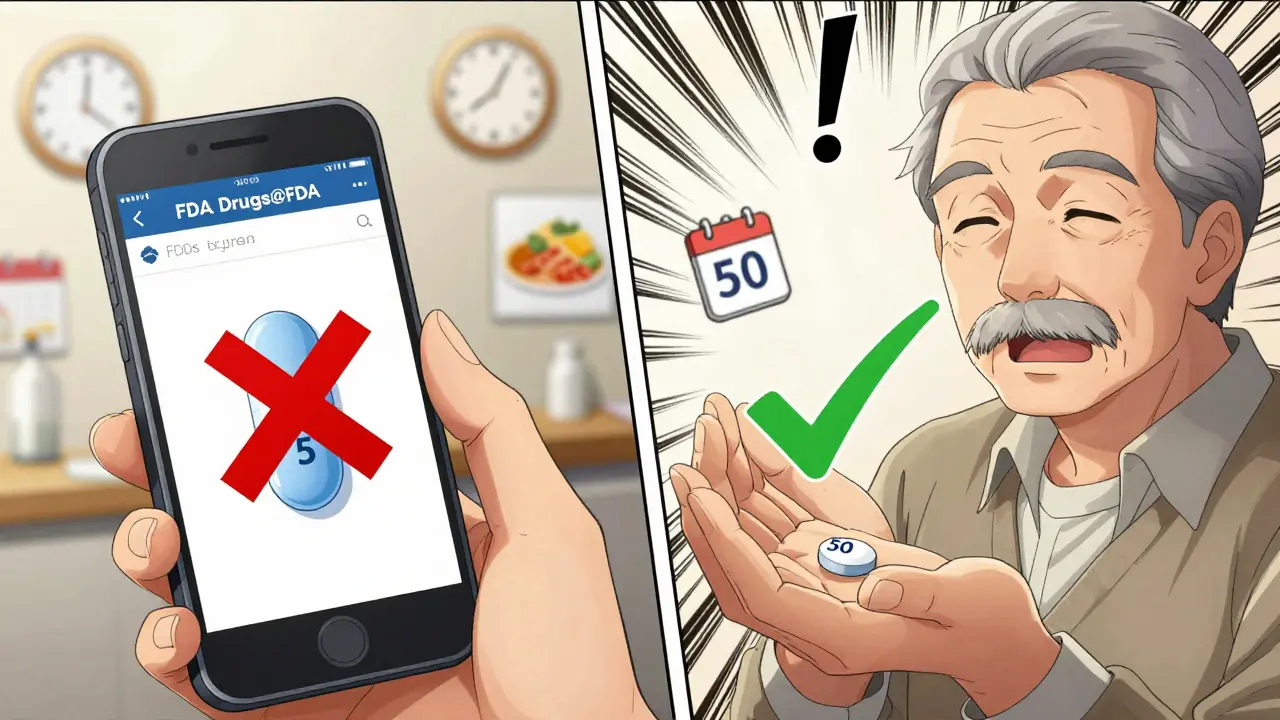
- Does the pill look right? Color? Shape? Markings? A blue oval with "5" on one side? That’s not the same as a white round pill with "50." Use the FDA’s Drugs@FDA database (you can search it on your phone) or ask the pharmacist for a reference image. A 2024 study showed patients who checked appearance caught 41% more errors than those who didn’t.
- Do the instructions match what your doctor told you? "Take once daily"? "Take with food"? "Take at bedtime"? If your doctor said "take in the morning" and the label says "take at night," speak up. The American Pharmacists Association found 14.2% of errors involve wrong directions. This isn’t about memory - it’s about alignment.
What to Do If Something’s Wrong
Don’t just nod and leave. Don’t say, "It’s probably fine." If any of these seven things don’t match - stop. Ask for the pharmacist. Say: "I’m checking my meds before I leave. This doesn’t match my prescription. Can you double-check?"Pharmacists are trained to handle this. In fact, the 2024 NACCHO Pharmacy Audit Guide recommends they prompt you to verify. If they seem annoyed, walk out and go to another pharmacy. Your safety matters more than their pride.
Pro tip: If you’re unsure about a pill’s appearance, ask for a printout of the drug image. Most pharmacies now have this. If they don’t, use the FDA’s Drugs@FDA website on your phone. It’s free. It’s real. It’s reliable.
Tools That Help - But Don’t Replace Your Eyes
There are apps like MedSafe (version 3.2, released Jan 2025) that scan barcodes and match them to your prescription. They’re 98.7% accurate. But they don’t catch everything. They can’t tell if the label says "5 mg" when the bottle says "50 mg." They can’t read handwriting. They don’t know if your doctor changed your dose last week.Smartphone cameras help - 57% of people under 50 use them to compare pill images. But seniors? Only 19% do. That’s why the CDC’s 2024 Medication Safety Kit includes laminated wallet cards with the seven-point checklist. You can get one free at 92% of U.S. pharmacies. Keep it in your wallet. Use it every time.
And if you have vision problems? Ask for a magnifying card. Since March 2024, 67% of Walgreens locations have started giving them out. CVS and Costco have improved label font sizes. But not all pharmacies have. If yours doesn’t, ask. If they refuse, go elsewhere.
Who’s Most at Risk - And Why
Older adults. People on five or more medications. People with low health literacy. These groups make up over 60% of serious medication errors. Why? Because labels are tiny. Instructions are confusing. Pill bottles are cluttered. And many don’t know what to look for.One Reddit user, u/MedSafetyMom, caught a 10x overdose on her child’s antibiotic because the label said "give 5" - no units. The bottle said "50 mg/5 mL." She noticed. She asked. Her child stayed safe.
Another user on Drugs.com said they almost took the wrong pill twice because of macular degeneration. They didn’t know what to check. They didn’t know where to get help. That’s why pictogram-based verification systems are now being tested at 12 community health centers - simple images of pills, arrows, clocks, and food.
If you’re caring for someone else - a parent, a partner - make this part of your routine. Don’t assume they’re doing it. Walk them through it. Sit with them. Ask the questions. Make it normal.
Why This Works - And Why It’s Growing
Pharmacies that train staff to prompt patients for verification see a 73% drop in errors. That’s not magic. That’s teamwork. The pharmacy does their job. You do yours. Together, you catch what neither could alone.California’s SB 793 law (effective Jan 1, 2025) now requires pharmacists to verbally ask: "Did you check your medication?" Other states are following. CMS is tying pharmacy reimbursement rates to patient verification rates starting in 2026. That means pharmacies will soon be financially incentivized to help you check your meds.
And the FDA’s new requirement - QR codes on labels by 2025 - will let you scan and instantly see the correct dosage, appearance, and instructions. But even then, you’ll still need to look. Technology helps. It doesn’t replace vigilance.
Start Today - It Takes Less Than a Minute
You don’t need to be perfect. You don’t need to memorize every pill. Just do the seven checks. Every time. No exceptions. Even if you’ve taken the same pill for ten years. Even if you trust the pharmacy. Even if you’re in a hurry.It’s not about being suspicious. It’s about being smart. The system isn’t broken. But it’s not flawless. You’re the final filter. And you’re the only one who can stop the mistake before it reaches you.
Next time you pick up your meds - pause. Look. Ask. Walk out with confidence - not just a bag of pills.
What if I don’t catch an error? Is it too late?
If you realize an error after leaving the pharmacy - don’t panic. Call them immediately. Most pharmacies will correct it, even if you’re at home. If you’ve already taken the wrong pill, call your doctor or Poison Control (1-800-222-1222). Most errors are caught before they cause harm - but the sooner you report it, the better.
Can I ask for a printed copy of my prescription?
Yes. By law, pharmacies must provide a printed copy of your prescription upon request. Keep it. Compare it to the label every time. It’s your record. And if there’s a mismatch, you have proof.
Do I need to check every single medication?
Yes. Even if it’s a refill. Even if you’ve taken it for years. Medications can change - your dose, your brand, your instructions. A 2024 study found 31% of errors happened on refills. Don’t assume. Always verify.
What if the pharmacist gets upset when I ask questions?
A good pharmacist will appreciate you. A bad one? That’s your sign to leave. Patient verification is a standard safety practice. If they act annoyed, it’s not about you - it’s about their training. Find another pharmacy. Your life is worth more than convenience.
Are there free resources to help me learn?
Yes. The CDC’s Medication Safety Kit includes free wallet cards with the seven-point checklist. The FDA’s MedCheck app (free on iOS and Android) helps you scan barcodes and compare pill images. Many pharmacies offer free 5-minute safety briefings - ask for one. You’re not alone. These tools exist to help you.


Author
Mike Clayton
As a pharmaceutical expert, I am passionate about researching and developing new medications to improve people's lives. With my extensive knowledge in the field, I enjoy writing articles and sharing insights on various diseases and their treatments. My goal is to educate the public on the importance of understanding the medications they take and how they can contribute to their overall well-being. I am constantly striving to stay up-to-date with the latest advancements in pharmaceuticals and share that knowledge with others. Through my writing, I hope to bridge the gap between science and the general public, making complex topics more accessible and easy to understand.