
FDA Drug Label Check
Check Your Drug Label
Before taking any prescription medication, verify you've reviewed these critical sections of the FDA drug label. Missing these could lead to serious safety issues.
Critical Sections
Select all sections you've reviewed:
Results
Every time you or someone you know takes a prescription medication, there’s a detailed document behind it - the FDA drug label. It’s not just a piece of paper in the box. It’s a legally required, scientifically rigorous guide that tells doctors and pharmacists exactly how to use the drug safely. But most people never look at it. And that’s a problem.
What You’re Really Looking At
The FDA drug label isn’t one thing. It’s a full system called the United States Prescribing Information (USPI). It’s been standardized since 2006 and updated regularly - most recently in March 2024. This isn’t marketing material. It’s the official, legally binding source of how a drug should be used. If a doctor prescribes something differently than what’s written here, they’re risking legal consequences. That’s how serious it is.
The label has three main parts: the Highlights, the Table of Contents, and the Full Prescribing Information (FPI). The Highlights section is only half a page long. It’s meant to give you the most urgent info fast - but it’s not enough. The FDA says clearly: "This section contains incomplete information. Always read the full prescribing information." If you only read the Highlights, you’re missing up to 90% of the critical details.
The 17 Sections You Need to Know
The Full Prescribing Information is broken into 17 numbered sections. Each one has a specific purpose. Here’s what matters most - and how to use them.
Section 1: Indications and Usage
This tells you what the drug is approved for. Not what it might help with. Not what your cousin swears by. Only what the FDA has reviewed and approved based on clinical trials. If your doctor wants to use it for something outside this section, that’s called "off-label" use - and it’s legal, but it means the safety data isn’t as strong.
Section 2: Dosage and Administration
This is where dosing details live. Not just "take one pill daily," but specifics like: "For patients with creatinine clearance below 30 mL/min, reduce dose to 5 mg once daily." It also includes instructions for special populations - kids, elderly, people with liver or kidney problems. Missing this section is how people end up with overdoses or underdoses.
Section 3: Dosage Forms and Strengths
Lists every version of the drug: tablets, capsules, injections, extended-release. Each has a unique 10-digit National Drug Code (NDC). That code is how pharmacies and insurance systems identify the exact product. If you see a different NDC than what’s on your prescription, something’s wrong.
Section 4: Contraindications
These are the red lights. If you have this condition, take this drug - and you could die. Examples: severe liver disease, allergy to the drug, or pregnancy in certain cases. This section is non-negotiable. If your doctor ignores it, ask why.
Section 5: Warnings and Precautions
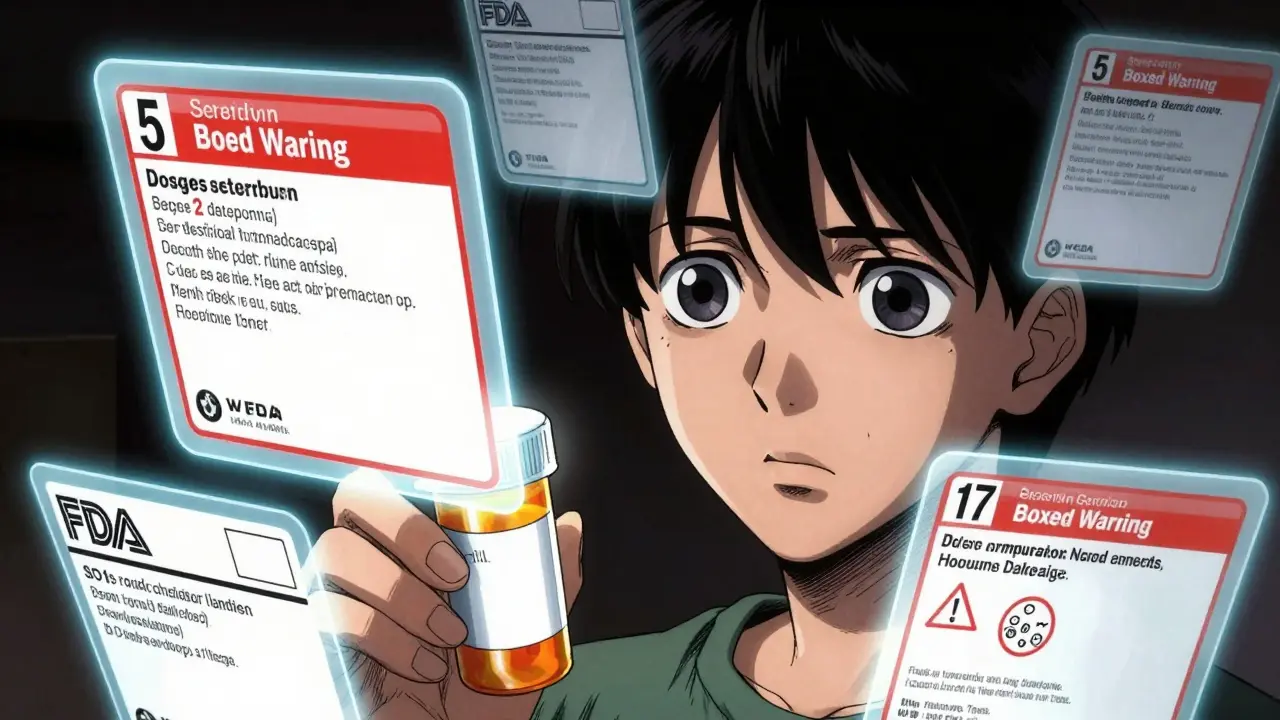
This is where the big risks live. And it starts with the Boxed Warning - the most serious risk, highlighted with a thick black border. These are things like increased suicide risk, heart failure, or life-threatening infections. If a drug has a Boxed Warning, it’s not a minor concern. It’s a red flag that changed how the drug was approved.
Section 6: Adverse Reactions
This lists side effects - and how often they happened in clinical trials. Not "you might get a headache." It says: "Headache occurred in 12% of patients vs. 5% in placebo." That tells you whether it’s common or rare. Don’t panic over a 1% risk. But if something shows up at 10% or higher, it’s something to watch for.
Section 7: Drug Interactions
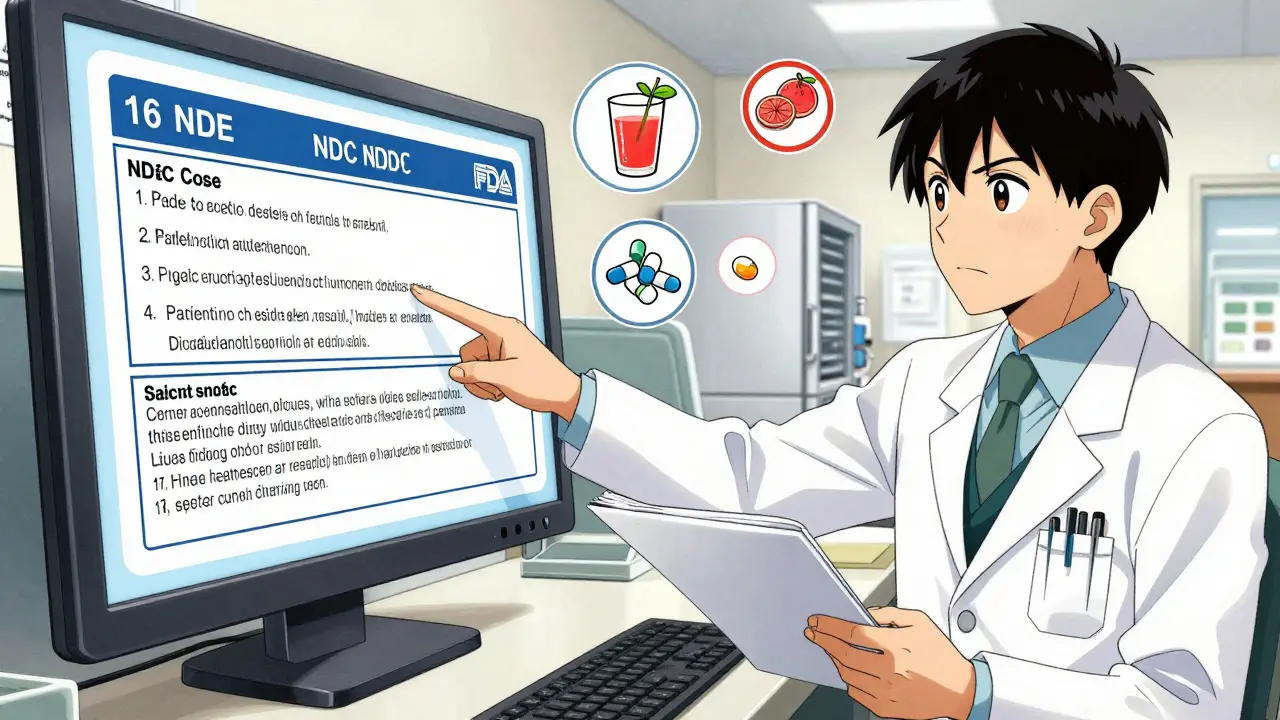
This section lists what other drugs, foods, or supplements can make this one dangerous. For example: "Avoid grapefruit juice - increases blood levels by 300%." Or: "Concomitant use with warfarin increases bleeding risk." This is why pharmacists ask you for your full list of meds. They’re checking this section.
Section 8: Use in Specific Populations
Does it work for pregnant women? Nursing mothers? Kids? Seniors? This section gives you the data - or admits there isn’t any. Many drugs have "insufficient data" for children or elderly patients. That doesn’t mean they’re unsafe - it means no one studied them enough. Ask your doctor if that applies to you.
Section 16: How Supplied / Storage and Handling
Looks boring, but it’s vital. This tells you how the drug is packaged, what the NDC is, and how to store it. Some drugs need refrigeration. Others must be kept away from light. If you store it wrong, it loses potency. And the NDC code? That’s how pharmacies track recalls. If your pill bottle has a different NDC than what’s listed here, call your pharmacy.
Section 17: Patient Counseling Information
This is the part doctors rarely use. It’s written in plain language - what you should tell your patient. For example: "Tell patients to avoid driving until they know how the drug affects them." Or: "Advise patients to report any signs of unusual bruising immediately." If your provider doesn’t mention these points, ask them to check Section 17.
What’s New? The Recent Major Changes Section
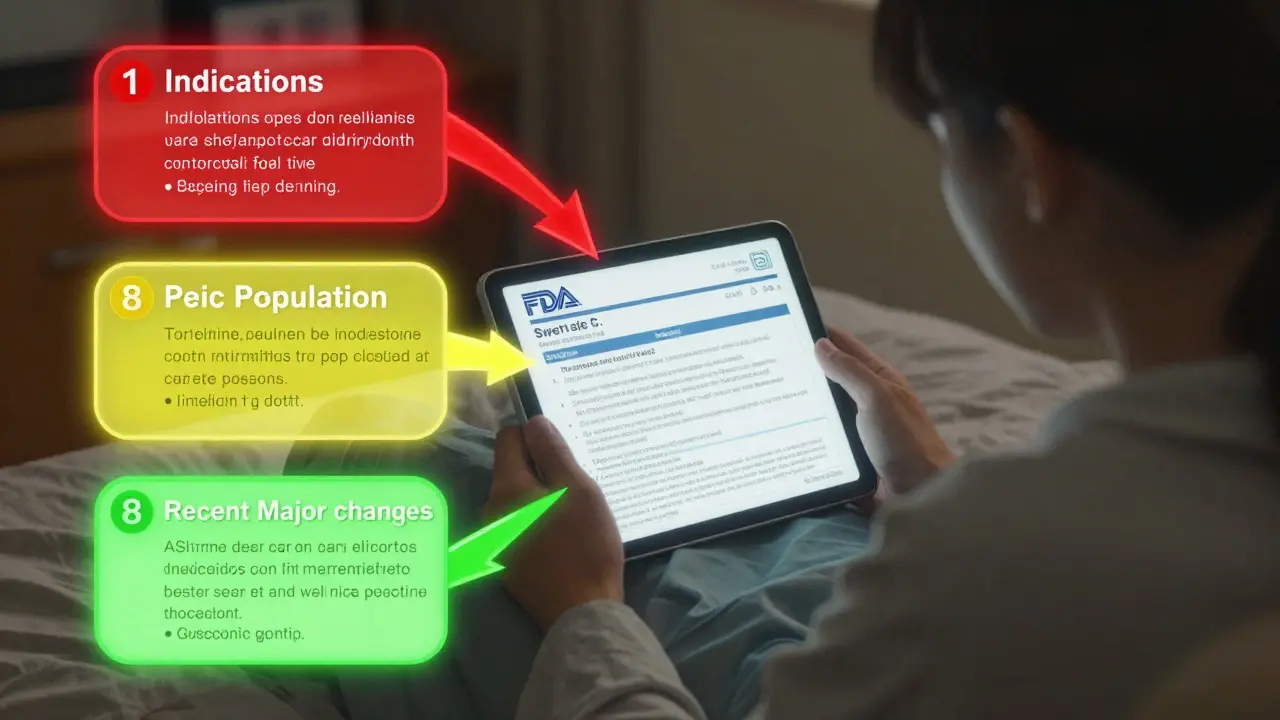
Since 2018, every label must include a "Recent Major Changes" section. It lists every part of the label that was updated in the last six months. Why? Because drug safety info changes. A new side effect might be discovered. A dosage might be adjusted. A drug interaction might be added. If you’re taking a drug you’ve been on for years, check this section before your next refill. About 35% fewer delays in updating prescriptions happen because of this section, according to FDA data.
How Professionals Use It - And How You Should
Doctors don’t read the whole thing every time. They follow a quick routine:
- Check the Boxed Warning first - is there a new life-threatening risk?
- Scan Highlights for quick facts - indications, max dose, contraindications.
- Jump to Section 2 (Dosage) and Section 7 (Interactions) - these are the most common causes of errors.
- Use Section 17 for patient education - don’t skip it.
Pharmacists focus on Sections 2, 3, 6, and 7. Why? Because 12.7% of dispensing errors come from confusing similar-looking drugs or wrong dosing. Section 16’s NDC helps them avoid that.
For patients: don’t rely on the Highlights alone. A 2024 study found 27% of patients misunderstood their drug’s risks because they only read the summary. Go to the full label. Search for your condition. Look up your other meds. Use Section 17 to ask smart questions.
Why This System Exists
In the early 2000s, over half of medication errors were linked to unclear labeling - wrong doses, missed interactions, unclear warnings. The FDA redesigned the whole system to fix that. Now, every label is in a digital format called Structured Product Labeling (SPL). It’s XML-based, machine-readable, and feeds directly into electronic health records. That’s why your doctor’s computer shows the exact same info as the printed label.
But it’s not perfect. A 2022 Mayo Clinic study found doctors spend nearly 5 minutes reading the full label during a patient visit - time they don’t always have. The FDA is testing new digital formats now - interactive labels that let you click to expand sections. The goal? Faster access to critical info without losing detail.
What Happens If It’s Wrong?
Companies that mislabel drugs face fines, warning letters, or even product recalls. In 2023 alone, the FDA issued 47 warning letters for labeling violations. That’s not a small number. It means someone missed a Boxed Warning, got the NDC wrong, or left out a key interaction. That’s why the system is so tightly controlled. It’s not bureaucracy - it’s protection.
What’s Coming Next
The FDA’s "Patient-Focused Labeling Initiative," announced in October 2024, may change how labels look. They’re testing ways to add clearer patient warnings, simpler language, and even QR codes linking to video explanations. By 2027, most new drugs might come with digital labels you can access on your phone.
But the core won’t change: the label is your safety net. It’s not optional. It’s not a suggestion. It’s the law.
Quick Checklist: What to Do Next
- Find the full prescribing information for your drug - search "[Drug Name] FDA label" on the FDA website.
- Check Section 5 for any Boxed Warning.
- Look at Section 2 - is your dose correct for your kidney or liver function?
- Scan Section 7 - are you taking anything that could interact?
- Read Section 17 - what should you be telling your doctor or pharmacist?
- Check the "Recent Major Changes" section - has anything been updated in the last six months?
You don’t need to be a doctor to use this. You just need to care enough to look.
Is the FDA drug label the same as the package insert?
Yes, the FDA drug label is the official version of the package insert. The term "package insert" is older and less precise. Since 2006, the FDA has required all prescription drugs to use the standardized Full Prescribing Information (FPI) format. What you get in the box is now legally required to match the FDA’s digital SPL file exactly.
Can I trust the side effects listed on the label?
The side effects listed are based on clinical trials - not real-world use. That means some rare reactions might not show up until thousands of people take the drug. The label is accurate for what was seen during testing, but it’s not a complete list of every possible side effect. If you experience something unusual, report it to your doctor and the FDA’s MedWatch program.
Why does the label say "for use by healthcare professionals" if I can read it?
The label is written for trained professionals - it uses medical terms and assumes knowledge of physiology. But it’s publicly available because patients have a right to know. You don’t need to understand every term. Focus on the bolded sections: Boxed Warning, Dosage, Contraindications, and Patient Counseling. Those are meant to be understood.
What if my doctor prescribes a dose not listed on the label?
That’s called off-label use, and it’s legal. But it means the FDA hasn’t approved that dose for your condition. Ask your doctor: "Is this dose supported by clinical evidence?" and "Has this been studied in patients like me?" The label is the baseline - not the ceiling.
How often are FDA drug labels updated?
On average, labels are updated every 14.3 months. But updates can happen faster if new safety risks are found. Always check the "Recent Major Changes" section before refilling a prescription - especially if you’ve been on the drug for over a year.


Author
Mike Clayton
As a pharmaceutical expert, I am passionate about researching and developing new medications to improve people's lives. With my extensive knowledge in the field, I enjoy writing articles and sharing insights on various diseases and their treatments. My goal is to educate the public on the importance of understanding the medications they take and how they can contribute to their overall well-being. I am constantly striving to stay up-to-date with the latest advancements in pharmaceuticals and share that knowledge with others. Through my writing, I hope to bridge the gap between science and the general public, making complex topics more accessible and easy to understand.