

You’ve just been prescribed a medication, and the first thing you think is: "Can I still feed my baby?" For many breastfeeding parents, this leads to the dreaded "pump and dump"-the act of expressing milk just to throw it away to avoid giving the baby any medication. But here is the reality: you are likely throwing away perfectly good milk for no scientific reason. According to the American Academy of Pediatrics, only a tiny fraction of medications are actually dangerous during breastfeeding. In fact, about 98% of medications have no documented risk to infants when used correctly. The goal isn't to avoid all medication, but to use a few smart timing strategies to keep your baby safe and your milk supply steady.
Quick Summary of Medication Safety
- Discarding milk is rarely necessary: "Pump and dump" is mostly based on outdated advice.
- Timing is everything: Feed your baby right before taking a dose to minimize exposure.
- Trust scientific databases: Use LactMed instead of the generic warnings on drug package inserts.
- Protect your supply: Unnecessarily stopping breastfeeding for even 24 hours can drop your milk supply by 30-50%.
The Truth About "Pump and Dump"
For years, many parents were told to pump and dump the practice of expressing breast milk and discarding it to prevent an infant from ingesting medication. This usually happened because pharmaceutical companies put blanket warnings on their labels to avoid legal liability, not because the drugs were actually dangerous. Research shows that this practice is incorrectly recommended in nearly 68% of cases. The truth is that very few medications-such as radioactive isotopes, certain chemotherapy drugs, or ergot alkaloids-require you to stop breastfeeding. For the vast majority of antibiotics, antidepressants, and pain relievers, the amount of drug that actually reaches the baby is clinically insignificant. When you throw away milk unnecessarily, you aren't just wasting a resource; you're risking your milk supply. Many parents find that interrupting breastfeeding for just a few days leads to a permanent drop in production that requires supplementation.
How Medications Actually Move Into Milk
To understand why most meds are safe, it helps to know how they move. A medication's risk depends on its pharmacokinetic properties the way a drug moves through the body, including its absorption, distribution, metabolism, and excretion>. Generally, a drug is less likely to affect a baby if it has a high molecular weight (over 500 Daltons), binds strongly to proteins in your blood, or has a very short half-life (under 4 hours).
Take common pain relievers as an example. If you take 650 mg of acetaminophen a common over-the-counter pain and fever reducer, the concentration in your milk is incredibly low-less than 0.1% of the maternal weight-adjusted dose. Similarly, ibuprofen a nonsteroidal anti-inflammatory drug used for pain and inflammation transfers at an even lower rate, often only 0.01% of the weight-adjusted infant dose. These levels are so low that they rarely cause any side effects in healthy infants.
| Medication | Relative Infant Dose | Risk Level | Typical Recommendation |
|---|---|---|---|
| Sertraline (Zoloft) | 0.5-2.5% | Very Low | Continue breastfeeding |
| Cephalexin (Keflex) | 0.5-1.5% | Very Low | Continue breastfeeding |
| Clindamycin | 5-15% | Low/Moderate | Monitor for infant diarrhea |
| Naproxen (Aleve) | N/A (Long half-life) | Moderate | Consult provider (longer persistence) |

Strategic Timing: The Better Alternative to Discarding Milk
Instead of throwing away milk, focus on timing. The goal is to breastfeed when the concentration of the medication in your blood is at its lowest. This usually happens right before your next dose or after the drug has had time to clear your system.
If you are taking a medication once a day, the best strategy is to take it immediately after your baby's longest sleep interval (usually after the bedtime feeding). This gives the drug 6 to 8 hours to clear before the next feeding. For medications taken multiple times a day, try to breastfeed immediately before you take your dose. By doing this, you ensure the baby gets the milk before the drug hits its peak concentration in your bloodstream.
Storing Milk While on Medication
One of the biggest myths is that medication changes how you should store your milk. It doesn't. Medication does not alter the physical properties or the stability of breast milk. Whether you are taking a prescription or not, the standard CDC guidelines the official health recommendations from the Centers for Disease Control and Prevention for breast milk storage apply:
- Room Temperature: Safe for up to 4 hours (at or below 25°C).
- Refrigerator: Safe for up to 4 days (at or below 4°C).
- Deep Freezer: Safe for up to 6 months (at -18°C).
If you are using a timing strategy and need to pump to maintain your supply or to avoid engorgement between feedings, you can store that milk as usual. You don't need to label it as "medicated" unless the drug is specifically known to have a long-lasting effect that requires a cautious approach, though this is rare for most standard prescriptions.
Reliable Resources for Your Peace of Mind
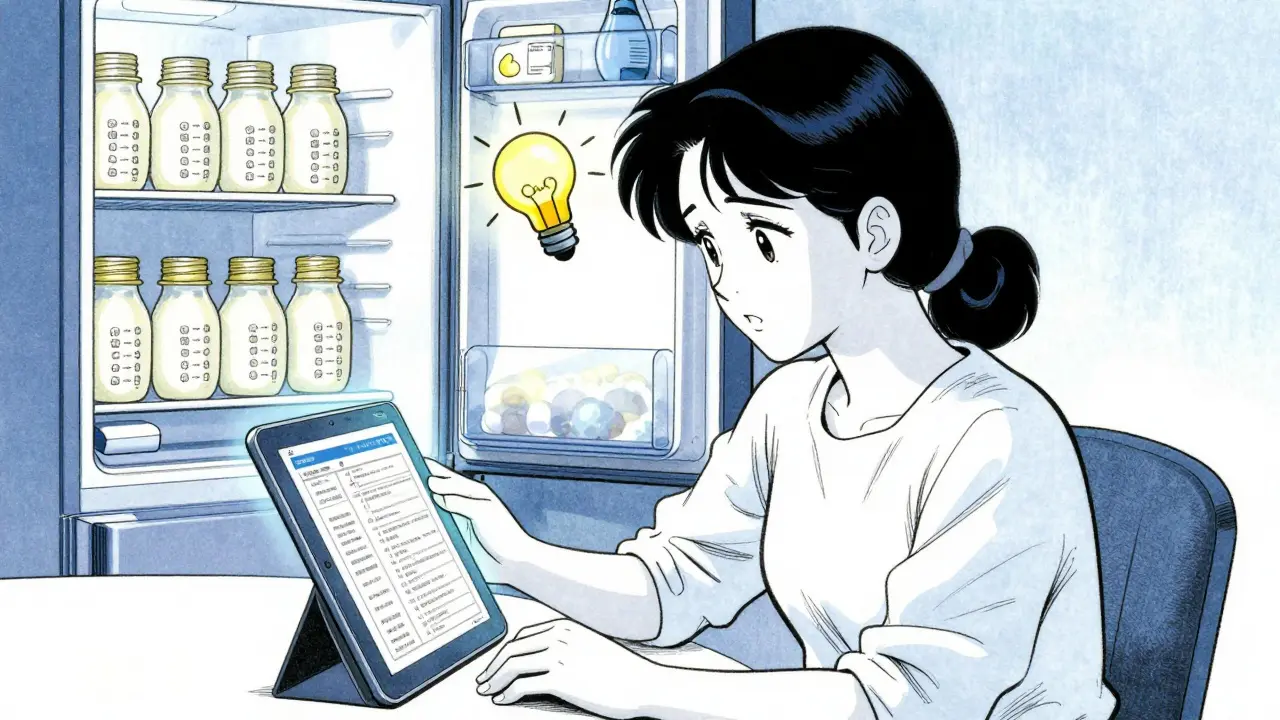
Your doctor is great, but they might not be an expert in lactation pharmacology. Many family physicians and obstetricians rely on the cautious warnings found in drug inserts. To get the most accurate, evidence-based information, you should use resources specifically designed for breastfeeding parents.
LactMed the National Institutes of Health's comprehensive database of drugs and lactation is the gold standard. It's updated weekly and provides scientific data on over 1,300 medications. If you need a human to talk to, the InfantRisk Center and MotherToBaby provide personalized guidance based on the latest research. These organizations look at the actual data-like molecular weight and protein binding-rather than generic warnings.
Do I really need to pump and dump if my doctor told me to?
Not necessarily. Many providers give this advice based on outdated labels. Before you throw away your milk, ask your provider why they believe the medication is unsafe. You can also check LactMed or contact the InfantRisk Center to see if the medication is actually contraindicated or if strategic timing is a better option.
Can medications cause my baby to have a reaction?
While most medications are safe, some can cause mild side effects. For example, certain antibiotics like clindamycin may cause diarrhea in some infants. This is why it's important to monitor your baby for changes in bowel habits or sleep patterns when starting a new medication, rather than just assuming you must stop breastfeeding.
What happens to my milk supply if I stop breastfeeding for a few days?
Interrupting breastfeeding for just 24 hours can reduce your milk supply by 30% to 50%. For many, this drop is permanent or very difficult to reverse. This is why using timing strategies and pumping to keep the breasts empty is much safer for your long-term breastfeeding goals than a complete "pump and dump" break.
Are over-the-counter (OTC) meds safer than prescriptions?
Not necessarily. Safety depends on the drug's chemistry, not whether it needs a prescription. Ibuprofen and acetaminophen (OTC) are generally very safe, but some OTC supplements or herbal remedies have very little research behind them, making them potentially riskier than some well-studied prescription drugs.
How do I know if a drug has a "short half-life"?
A half-life is the time it takes for the concentration of the drug in your body to reduce by half. You can find this information in the "Pharmacokinetics" section of a drug's professional monograph or by searching the medication on LactMed. Drugs with a half-life of less than 4 hours are generally easier to time around feedings.
Next Steps for Parents
If you find yourself needing medication while breastfeeding, don't panic and don't start throwing away milk immediately. First, look up the drug on LactMed. If you are unsure, call the InfantRisk Center for a professional risk assessment. If your doctor suggests pumping and dumping, politely ask for the specific evidence or suggest a timing strategy instead. By staying informed and using a bit of scheduling, you can take care of your own health without compromising your breastfeeding journey.
Author
Mike Clayton
As a pharmaceutical expert, I am passionate about researching and developing new medications to improve people's lives. With my extensive knowledge in the field, I enjoy writing articles and sharing insights on various diseases and their treatments. My goal is to educate the public on the importance of understanding the medications they take and how they can contribute to their overall well-being. I am constantly striving to stay up-to-date with the latest advancements in pharmaceuticals and share that knowledge with others. Through my writing, I hope to bridge the gap between science and the general public, making complex topics more accessible and easy to understand.