
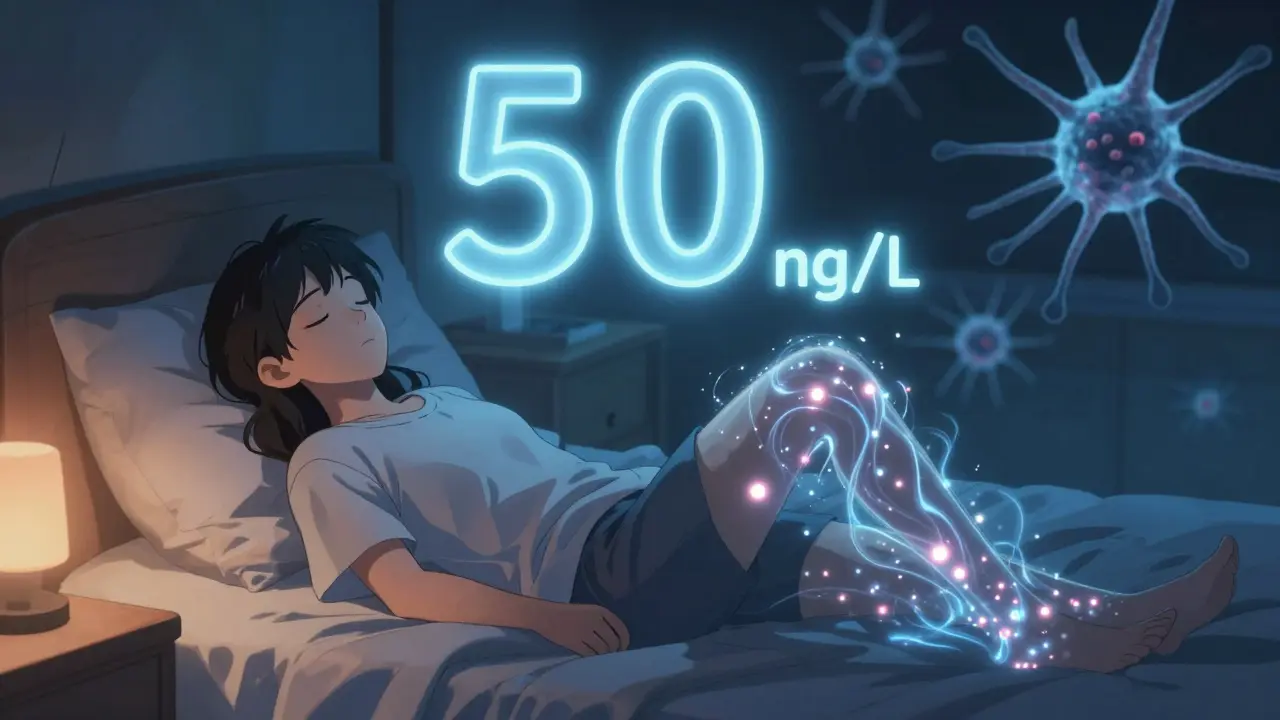
Restless Legs Syndrome (RLS) isn’t just about discomfort-it’s often a sign your brain isn’t getting enough iron, even if your blood tests look fine. If you’re lying in bed at night, your legs twitching, crawling, or aching, and you feel an unbearable urge to move, you’re not alone. About 1 in 10 adults in the U.S. have RLS, and for many, the root cause isn’t stress or bad sleep habits-it’s low ferritin. This isn’t a myth. It’s science. And correcting it can change your life.
Why Iron Matters More Than You Think
Most people think iron is just for anemia. But in RLS, it’s about brain iron, not blood iron. Your body might have normal hemoglobin and serum iron, but if ferritin-the stored form of iron-is below 50 ng/mL, your brain’s dopamine system starts to malfunction. That’s what triggers the restless legs. Studies show this isn’t coincidence. In 1997, researchers found RLS patients had an average ferritin level of 28.4 ng/mL. Healthy controls? 62.1 ng/mL. That gap didn’t happen by accident.
The problem? Standard blood tests often say your iron is "normal" because they only check serum iron or hemoglobin. Ferritin tells the real story. The American Academy of Sleep Medicine now says: if you have RLS, test ferritin first. No exceptions. If it’s under 50, you’re likely iron-deficient in your brain-even if you don’t have anemia.
The Magic Number: 50 ng/mL
Why 50? Because that’s the threshold where symptoms start to improve. Below 50 ng/mL, your chances of responding to iron therapy jump to over 50%. Above 75, and the benefit drops off sharply. This isn’t a guess. It’s backed by double-blind trials published in Sleep Medicine and Neurology. One study showed 52% of patients with ferritin under 50 had at least half their symptoms vanish after iron treatment. Only 18% of placebo patients did.
Here’s the twist: many doctors still treat ferritin below 12 as low. But for RLS, 12 is too low. 50 is the new floor. The European Restless Legs Syndrome Study Group, Johns Hopkins, and the American Academy of Neurology all agree: if your ferritin is below 50, treat it. Don’t wait for anemia. Don’t wait for worse symptoms. Start now.
Oral Iron: What Works, What Doesn’t
If your ferritin is under 50, oral iron is your first step. But not all iron pills are equal. Ferrous sulfate (325 mg) gives you 65 mg of elemental iron-the dose most studies use. Take it on an empty stomach. Or better yet, take it with 100-200 mg of vitamin C. That boosts absorption by up to 40%.
Side effects? About 1 in 3 people get nausea, constipation, or stomach pain. That’s why many doctors now recommend alternate-day dosing. One day on, one day off. It cuts side effects by half and doesn’t hurt effectiveness. A 2020 study in Blood Advances proved it: same ferritin rise, fewer stomach issues.
Don’t waste time on cheap iron supplements. Look for ferrous sulfate, ferrous fumarate, or ferrous gluconate. Avoid heme iron from food alone. A 4-ounce steak gives you maybe 1-2 mg of absorbable iron. You need 65 mg daily. No way you’re getting there from diet.
When Oral Iron Fails: IV Iron
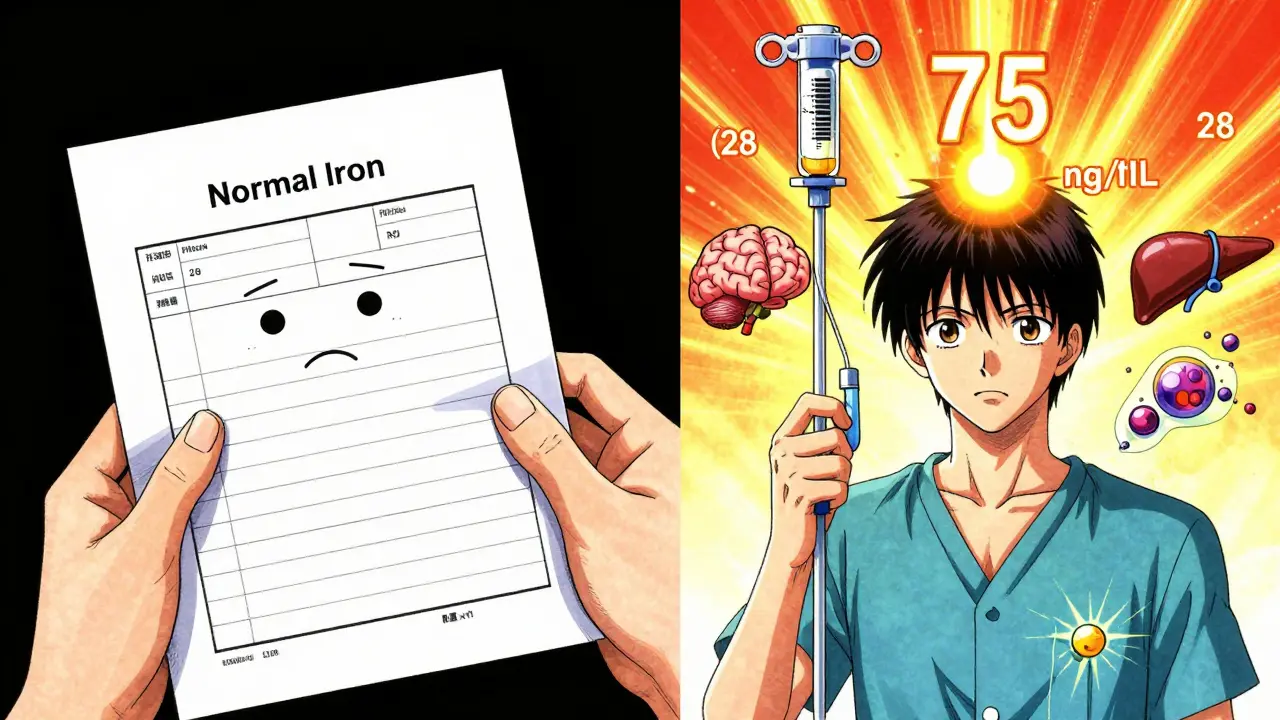
If you’ve tried oral iron for 8-12 weeks and ferritin is still under 50, or you can’t tolerate it, IV iron is the next step. It’s not extreme. It’s routine. Ferric carboxymaltose (1000 mg single infusion) raises ferritin by an average of 127 ng/mL in just 6 weeks. In one trial, 68% of patients saw major symptom improvement.
IV iron isn’t for everyone. But if your ferritin is below 30, or you’ve got severe RLS, it’s often the only thing that works. And it’s safer than long-term dopamine drugs. Pramipexole and ropinirole can make RLS worse over time-up to 70% of patients develop augmentation, where symptoms start earlier, spread to arms, or get worse. Iron doesn’t do that. Ever.
What About Diet and Natural Fixes?
Red meat, liver, spinach, lentils-yes, they have iron. But you’d need to eat 10 steaks a day to match one iron pill. Heme iron (from animals) is better absorbed than plant iron, but even then, you’re talking about 1-2 mg per serving. You need 65 mg. That’s not realistic.
Don’t rely on vitamin C alone. Don’t count on acupuncture, massage, or magnesium (though they might help a little). Iron repletion is the only treatment proven to fix the root cause. Everything else is support, not solution.
Monitoring Your Progress
Don’t just take iron and hope. Test again. After 8-12 weeks, get your ferritin rechecked. Target? 75-100 ng/mL. That’s the sweet spot for long-term control. One study found patients who hit this range had symptom relief last over 24 months-without any dopamine drugs.
Also, check your transferrin saturation and serum iron. If ferritin is low but transferrin saturation is under 20%, you’ve got a real deficiency. If it’s above 45%, you might have inflammation or another issue. Don’t skip these tests.
Iron vs. Dopamine Drugs: The Real Choice
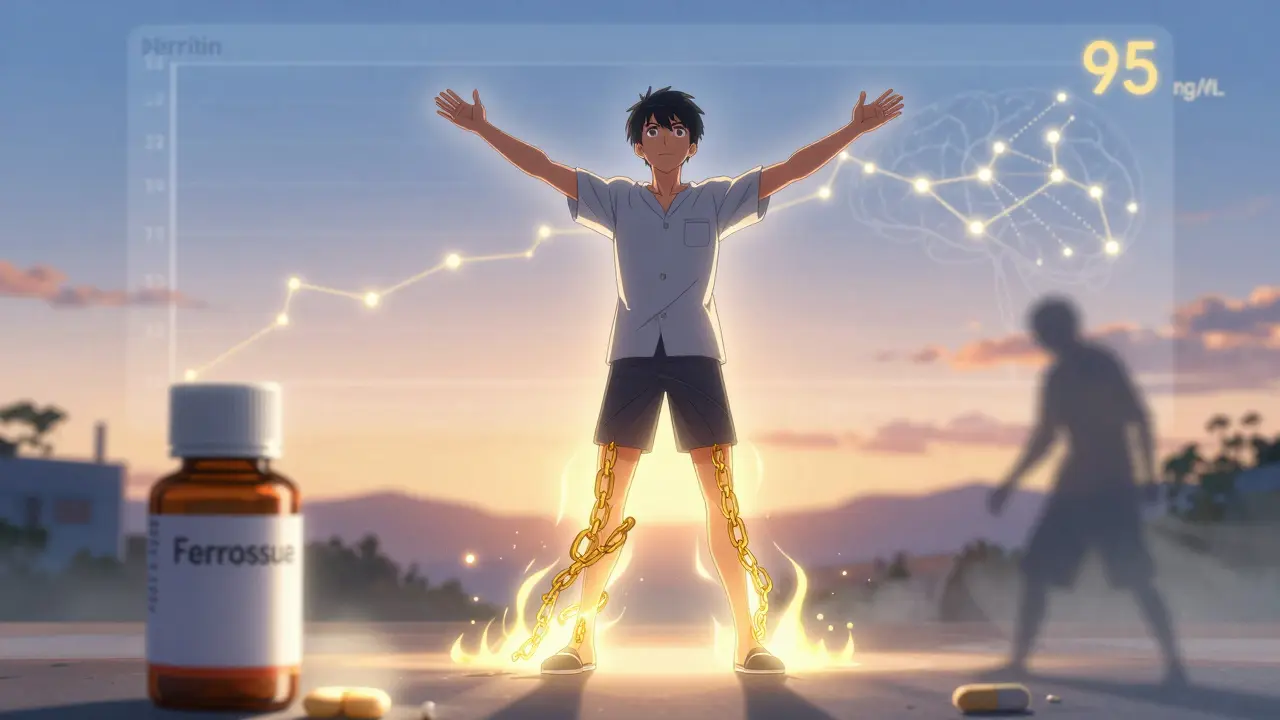
Most doctors start RLS patients on pramipexole or ropinirole because they work fast. But here’s the trade-off: 6-8% of patients develop augmentation each year. After 10 years? Up to 70% are worse off than when they started.
Iron? No augmentation. No tolerance. No withdrawal. Just slow, steady improvement. It takes 4-8 weeks to feel better. But once you do, it lasts. And it costs less. A year of oral iron? $185-$350. A year of dopamine drugs? $2,400-$4,800. And that’s not counting side effects like dizziness, nausea, or compulsive gambling-a real risk with dopamine agonists.
If your ferritin is under 75, iron should come first. The American Academy of Neurology gives it a "probably effective" rating. That’s a strong endorsement. And sleep specialists surveyed in 2023 said 87% of them now prioritize iron before dopamine drugs.
What’s Next? New Iron Formulations
Researchers are testing better iron. Liposomal iron and ferric maltol are in phase II trials. Early results show 40% better absorption and 60% fewer stomach problems than ferrous sulfate. These could be game-changers. But they’re not widely available yet.
One more thing: hepcidin. This hormone blocks iron from entering your brain. RLS patients often have higher hepcidin levels-even when ferritin is low. That’s why some people don’t respond to oral iron. If your hepcidin is over 10 ng/mL and ferritin under 50, your chance of improvement jumps to 78%. Testing hepcidin isn’t routine yet, but it’s coming.
Bottom Line: Test. Treat. Track.
Restless legs aren’t just annoying. They’re a signal. Low ferritin is the most common, treatable cause. If you have RLS:
- Get your ferritin tested-don’t assume your iron is fine.
- If it’s under 50 ng/mL, start iron therapy.
- Use 65 mg elemental iron daily (ferrous sulfate) with vitamin C.
- If side effects hit, switch to alternate-day dosing.
- If no improvement after 3 months, consider IV iron.
- Re-test ferritin at 8-12 weeks. Aim for 75-100 ng/mL.
- Delay dopamine drugs unless iron fails or ferritin is above 75.
This isn’t about supplements. It’s about fixing a biological gap. Iron isn’t a cure-all. But for half the people with RLS, it’s the missing piece.
Can low ferritin cause restless legs even if I’m not anemic?
Yes. Anemia means low hemoglobin. Ferritin measures stored iron. You can have normal hemoglobin but still have brain iron deficiency, which directly triggers RLS. Studies show RLS patients often have ferritin below 50 ng/mL while their hemoglobin stays normal. Treating low ferritin improves symptoms even without anemia.
How long does it take for iron supplements to work for restless legs?
It usually takes 4 to 8 weeks to notice improvement. Some people feel better in 2-3 weeks, especially with IV iron. But full benefit often takes 3 months. Don’t stop too early. Iron builds up slowly in the brain, and symptoms won’t vanish overnight.
Is it safe to take iron supplements long-term?
Yes, if monitored. Oral iron is safe for long-term use as long as ferritin levels are checked every 6-12 months. The goal is to maintain ferritin between 75-100 ng/mL. Too much iron (ferritin over 300) can be harmful, so regular testing prevents overload. IV iron is typically given as a single dose or occasional boost, not daily.
Why do some people with low ferritin not respond to iron supplements?
Two main reasons: poor absorption or high hepcidin. Some people have gut issues that block iron uptake. Others have elevated hepcidin, a hormone that locks iron out of the brain. If ferritin stays low despite oral iron, IV iron bypasses gut absorption. Testing hepcidin levels (if available) can help identify non-responders.
Should I avoid dopamine medications if I start iron therapy?
Yes-if your ferritin is under 75 ng/mL. Iron therapy addresses the root cause with no risk of worsening symptoms. Dopamine drugs like pramipexole can cause augmentation, where RLS becomes more severe over time. Experts now recommend trying iron first. Only use dopamine drugs if iron fails or ferritin is above 75.
Can I get enough iron from food to treat RLS?
No. One 4-ounce serving of red meat gives you 1-2 mg of absorbable iron. To reach the 65 mg daily dose used in studies, you’d need to eat 30-60 servings a day. That’s impossible. Supplements are necessary. Diet helps support iron levels but can’t replace therapeutic dosing for RLS.
What’s the difference between ferritin and serum iron?
Ferritin measures stored iron in your liver and brain. Serum iron is the amount circulating in your blood right now. Serum iron fluctuates daily and isn’t reliable for diagnosing deficiency. Ferritin is stable and reflects long-term iron status. For RLS, ferritin is the only number that matters.
Is IV iron painful or risky?
IV iron is given as a single infusion over 15-30 minutes. Most people feel nothing. Mild side effects include headache, dizziness, or temporary low blood pressure. Severe reactions are rare (under 1%). It’s far safer than long-term dopamine drugs. It’s also covered by most insurance when ferritin is below 50 ng/mL and oral iron failed.
Restless legs aren’t a life sentence. For many, they’re a simple fix: test ferritin, treat iron deficiency, and reclaim your nights. It’s not glamorous. But it works.


Author
Mike Clayton
As a pharmaceutical expert, I am passionate about researching and developing new medications to improve people's lives. With my extensive knowledge in the field, I enjoy writing articles and sharing insights on various diseases and their treatments. My goal is to educate the public on the importance of understanding the medications they take and how they can contribute to their overall well-being. I am constantly striving to stay up-to-date with the latest advancements in pharmaceuticals and share that knowledge with others. Through my writing, I hope to bridge the gap between science and the general public, making complex topics more accessible and easy to understand.