
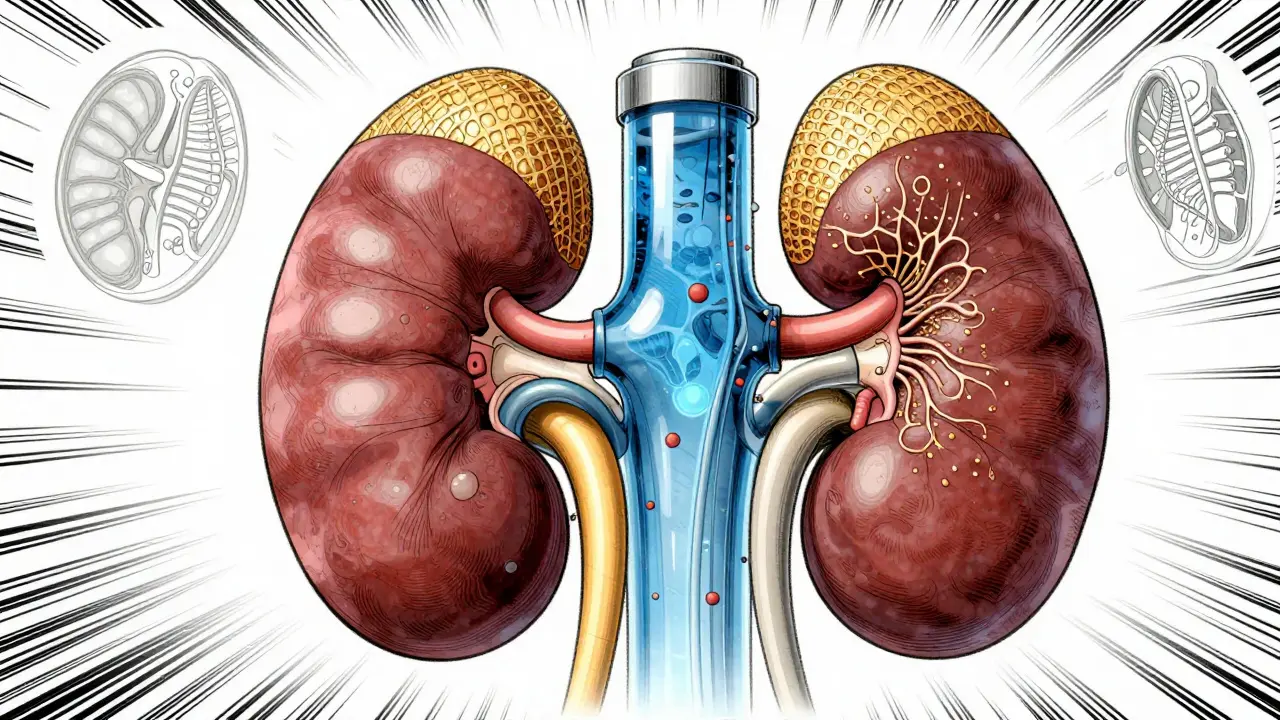
You might have noticed a few confusing numbers on your latest blood work, like "Creatinine" or "eGFR." If you're looking at these results and wondering what they actually mean for your health, you're not alone. Most of us don't think about our kidneys until a doctor mentions a "function test," but these organs are essentially the high-tech filtration system of your body. When they don't work right, waste builds up in your blood, which can lead to serious issues if left unchecked. The good news? We have very precise ways to catch these problems early. Kidney Function Tests are standardized medical diagnostic procedures used to evaluate the filtration capacity and overall health of the kidneys. By combining blood work and urine samples, doctors can see not just if your kidneys are working, but exactly how efficiently they are cleaning your blood.
The Role of Serum Creatinine
To understand how doctors check your kidneys, you first have to understand Serum Creatinine. This is a waste product that comes from the normal wear and tear of your muscles. Because your kidneys are responsible for filtering creatinine out of your blood and sending it to your bladder, the amount of it staying in your blood is a huge clue about your kidney health. If your kidneys are sluggish, creatinine levels rise.
However, there is a catch. Creatinine is what we call a "late marker." Research from Physiopedia indicates that you might actually lose about 50% of your kidney function before your serum creatinine levels show a significant spike. This is why your doctor won't rely on this number alone. Also, because creatinine comes from muscle, a bodybuilder and a frail elderly person might have very different "normal" levels even if their kidneys are performing similarly. This is where the next test comes in.
Cracking the Code of eGFR
Since creatinine levels vary by person, doctors use a calculation called eGFR (Estimated Glomerular Filtration Rate). Think of the glomeruli as the tiny biological strainers in your kidneys. The GFR is essentially a measure of how many milliliters of blood these strainers can clean per minute. Since we can't easily measure this directly in a living person, we estimate it using a formula.
Modern medicine primarily uses the CKD-EPI equation, which takes your serum creatinine and plugs it into a formula along with your age and sex. This gives a much more accurate picture than creatinine alone. According to the National Kidney Foundation, an eGFR of 90 or higher is generally considered normal. Once that number dips to 60 or below, it may be a sign of kidney disease.
| Stage | eGFR Range (ml/min/1.73 m²) | What it Means |
|---|---|---|
| Stage 1 | 90 or higher | Normal or mild damage |
| Stage 2 | 60 to 89 | Mildly decreased function |
| Stage 3a/3b | 30 to 59 | Moderate to severe decrease |
| Stage 4 | 15 to 29 | Severely compromised function |
| Stage 5 | Below 15 | Kidney failure (End-stage) |
Why Urinalysis is the "Early Warning System"
If eGFR is the measure of how much your kidneys are filtering, Urinalysis is the measure of how well they are filtering. Imagine a kitchen strainer with a tiny hole in it; water still goes through, but some chunks of food leak out. In your kidneys, those "chunks" are proteins like albumin.
The CDC notes that protein leaking into the urine (proteinuria) is often one of the earliest signs of kidney disease, sometimes appearing long before the eGFR drops. This is why the Albumin-Creatinine Ratio (ACR) is the gold standard for screening. By comparing the amount of albumin to the amount of creatinine in a single urine sample, doctors can determine if your kidney membranes are leaking. If your ACR result falls between 3-70 mg/mmol, your doctor will likely ask for an early morning sample to confirm the result, as protein levels can fluctuate throughout the day.
Other Specialized Kidney Tests
Depending on your risk factors, your doctor might suggest tests that go beyond a standard dipstick or blood draw. You might hear about Blood Urea Nitrogen (BUN). This measures urea, a waste product from the protein you eat. While useful, BUN is less specific than creatinine because it can be affected by your diet or dehydration.
For people where creatinine might be misleading-such as those who are very muscular, pregnant, or under 18-doctors may use a Cystatin C test. Unlike creatinine, Cystatin C is produced by all nucleated cells in the body at a constant rate, making it a more stable marker for GFR estimation in unique populations.
Then there is the 24-hour urine collection. While it feels like a chore, this test is incredibly detailed. By collecting every drop of urine for a full day, doctors can precisely measure excess protein and other substances like sodium, potassium, and oxalates, which provides a total daily snapshot of kidney performance.

Who Needs These Tests and How Often?
Not everyone needs a full renal panel every month, but certain people should be proactive. If you have Diabetes or Hypertension (high blood pressure), you are at a significantly higher risk. These two conditions are the leading causes of kidney damage because they put constant pressure on the delicate filters in the glomeruli.
The UK Kidney Association recommends regular testing with both eGFR and urine ACR for high-risk patients. This "two-pronged" approach ensures that if the blood test misses a slight dip in function, the urine test will catch the protein leak. For the general population, a basic metabolic blood test once a year is usually sufficient to keep an eye on things.
Making Sense of Your Results
When you get your results back, don't panic over one slightly off number. Kidney function can fluctuate based on a few factors:
- Hydration: Dehydration can artificially raise your creatinine and BUN levels.
- Medications: Some drugs can interfere with how creatinine is secreted, making your kidneys look better or worse than they are.
- Diet: A very high-protein diet or taking creatine supplements for the gym can skew your results.
The most important thing is the trend. A single eGFR of 58 is less concerning than an eGFR that was 80 last year and is now 58. Always discuss the trajectory of your numbers with your healthcare provider.
Is a high creatinine level always a sign of kidney disease?
Not necessarily. Because creatinine is a byproduct of muscle metabolism, people with very high muscle mass (like athletes) often have higher baseline levels. Additionally, severe dehydration or certain medications can cause a temporary spike. This is why doctors use the eGFR calculation to put the creatinine number into context.
What is the difference between eGFR and Creatinine?
Creatinine is a physical substance (a waste product) measured in your blood. eGFR is a calculated number that uses your creatinine level, age, and sex to estimate how much blood your kidneys are filtering per minute. Creatinine is the raw data; eGFR is the interpreted result.
Why is the urine ACR test preferred over a dipstick?
Dipsticks are essentially chemically treated paper that change color. They are convenient but lack precision and can miss small amounts of protein. The ACR (Albumin-Creatinine Ratio) is a quantitative test, meaning it provides an exact measurement, making it much more sensitive for early detection of kidney damage.
Can kidney function be restored once it drops?
It depends on the cause. Acute Kidney Injury (AKI) caused by sudden dehydration or medication toxicity can often be reversed. However, Chronic Kidney Disease (CKD) involves permanent scarring of the filters. In these cases, the goal isn't usually to "restore" the function but to slow the progression and preserve as much remaining function as possible.
How often should I have my kidney function checked?
For most healthy adults, a check during an annual physical is enough. However, if you have diabetes, high blood pressure, or a family history of kidney failure, your doctor will likely recommend testing every 6 to 12 months to catch any changes early.
Author
Mike Clayton
As a pharmaceutical expert, I am passionate about researching and developing new medications to improve people's lives. With my extensive knowledge in the field, I enjoy writing articles and sharing insights on various diseases and their treatments. My goal is to educate the public on the importance of understanding the medications they take and how they can contribute to their overall well-being. I am constantly striving to stay up-to-date with the latest advancements in pharmaceuticals and share that knowledge with others. Through my writing, I hope to bridge the gap between science and the general public, making complex topics more accessible and easy to understand.